





FMIC is staffed by professionals from diverse backgrounds. To address the persistent and dynamic threat from foreign malign influence, the FMIC team engages with colleagues from a wide variety of institutions, including other IC agencies, the wider U.S. Government (including law enforcement and diplomatic elements), the private sector, civil society, and academia. We welcome mission-oriented applicants with functional and regional expertise who want to join us in mitigating this challenging problem.
The ODNI seal incorporates the DNI's charge to oversee and coordinate the foreign and domestic activities of the United States Intelligence Community. The elements depicted in the ODNI seal symbolize: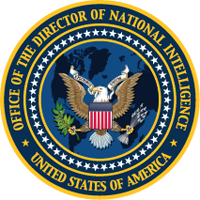
- American Bald Eagle: derived from the Great Seal of the United States, the eagle represents the sovereignty of the U.S.;
- Escutcheon or shield: composed of 13 stripes, white signifying purity and innocence, and red signifying hardiness and valor;
- "E Pluribus Unum": Latin for "out of many, one," signifies this new organization uniting the many organizations in the Intelligence Community;
- Olive branch: represents the power of peace;
- 13 arrows: represents the power of war;
- Field of blue (background of the seal): signifying vigilance, perseverance and justice;
- 50 white stars: represent the 50 states of the United States; and
- Gold lettering: spelling out "Office of the Director of National Intelligence" and "United States of America" symbolize integrity and the highest ideals and goals.
Usage of the ODNI seal, as well as the name and initials, is governed by the ODNI Instruction Number 2005-08; Official Use of the Name, Initials, or Seal of the Office of the Director of National Intelligence. The instruction indicates that usage of the seal, name, or initials is authorized for individuals within the ODNI for official business and is governed by the deputy directors or heads of ODNI components. No person may knowingly use the official name, initials, or seal in connection with any commercial activity without authorization from the ODNI in writing.
Download the ODNI Seal
- .png (540k)

The idea of a Director of National Intelligence dates to 1955 when a blue-ribbon study commissioned by Congress recommended that the Director of Central Intelligence employ a deputy to run the CIA so that the director could focus on coordinating the overall intelligence effort. This notion emerged as a consistent theme in many subsequent studies of the Intelligence Community commissioned by both the legislative and executive branches over the next five decades.
LESSONS OF SEPT. 11, 2001

Remains of the World Trade Center Friday, Sept. 14, 2001 in New York City.
(U.S. National Archives)
The attacks of Sept. 11, 2001, moved forward the longstanding call for major intelligence reform and the creation of a Director of National Intelligence. Post-9/11 investigations included a joint Congressional inquiry and the independent National Commission on Terrorist Attacks Upon the United States (better known as the 9/11 Commission). The 9/11 Commission's report in July 2004 proposed sweeping change in the Intelligence Community, including the creation of a National Intelligence Director.
INTELLIGENCE REFORM
 Very soon after the report was released, the federal government moved forward to undertake reform. President Bush signed four Executive Orders in August 2004 that strengthened and reformed the Intelligence Community as much as possible without legislation. In Congress, both the House and Senate passed bills with major amendments to the National Security Act of 1947.
Intense negotiations to reconcile the two bills ultimately led to the Intelligence Reform and Terrorism Prevention Act of 2004 (IRTPA), which President Bush signed into law on Dec.17, 2004.
LAUNCH OF THE ODNI
In February 2005, the President nominated John D. Negroponte, ambassador to Iraq, as the first director of national intelligence and U.S. Air Force Lt. Gen. Michael V. Hayden as the first principal deputy DNI, promoting him to General. On April 21, 2005, in the Oval Office, Amb. Negroponte and Gen. Hayden were sworn in, and the ODNI began operations at 7 a.m. on April 22, 2005.
Previous directors include John M. ("Mike") McConnell (Vice Adm., USN Ret.), Dennis Blair (Adm., USN Ret.), James R. Clapper (Lt. Gen., USAF Ret.), Dan Coats, John Ratcliffe, and Avril Haines.