Global Trends 2040

Cyber Training Series

DEEPER LOOKS

The Future of International Norms:
US-Backed International Norms Increasingly Contested PDF Version - Download

This paper was produced by the National Intelligence Council’s Strategic Futures Group in consultation with outside experts and Intelligence Community analysts to help inform the integrated Global Trends product, which published in March 2021. However, the analysis does not reflect official US Government policy, the breadth of intelligence sources, or the full range of perspectives within the US Intelligence Community.

Diverse global actors with divergent interests and goals are increasingly competing to promote and shape international norms on a range of issues, creating greater challenges to the US-led international order than at any time since the end of the Cold War. Some democracies are retreating from their longstanding role as norms leaders and protectors as populist influence grows. At the same time, authoritarian powers led by China and Russia are reinterpreting sovereignty norms, offering alternatives to what they view as US-centric norms, such as individual human rights, and using norms and standards to promote their influence. Nonstate actors and smaller states are often key players who try to overcome normative impasses and, in some cases, step in to fill perceived gaps. During the next decade, this increased competition will limit the effectiveness of international efforts to address global challenges and increase the risk of armed interstate conflict, although major powers are still likely to uphold norms in mutually beneficial areas. 

Scope Note: This paper focuses on selected international norms supported by the United States that we assess to be most under stress, particularly in the human rights and security areas. It draws on norms in other areas including sovereignty, environment, and economics. The focus is not on the future of global governance or international institutions, and it avoids commenting on broad principles, social and domestic norms or technical standards. Principles articulate group goals and visions but do not assign responsibility for achieving them. Technical standards are norms that articulate consensus regarding the specifications for a particular technology, signal, or system.


DEFINITIONS

This paper examines the future of international norms during the next decade using the following definitions:

  • Norms: Shared expectations about what constitutes appropriate behavior held by a community of actors. Norms can form at the international, regional, state, or sub-state level and attempt to guide desirable behavior.
  • International norms: Widely shared expectations about what constitutes appropriate behavior among governments and certain non-state actors at the international level. Non-binding frameworks, such as voluntary codes of conduct or conventions, sometimes set the scene for more formal, binding agreements.
  • International legal norms: Generally referred to as international law, these norms are binding on actors and typically formalized in written agreements, particularly treaties.
  • Norm entrepreneurs: Actors who leverage the reputational sensitivity among states and other entities to develop and lobby for norms. Many norm entrepreneurs seek to encode norms in legal instruments to improve and broaden compliance.


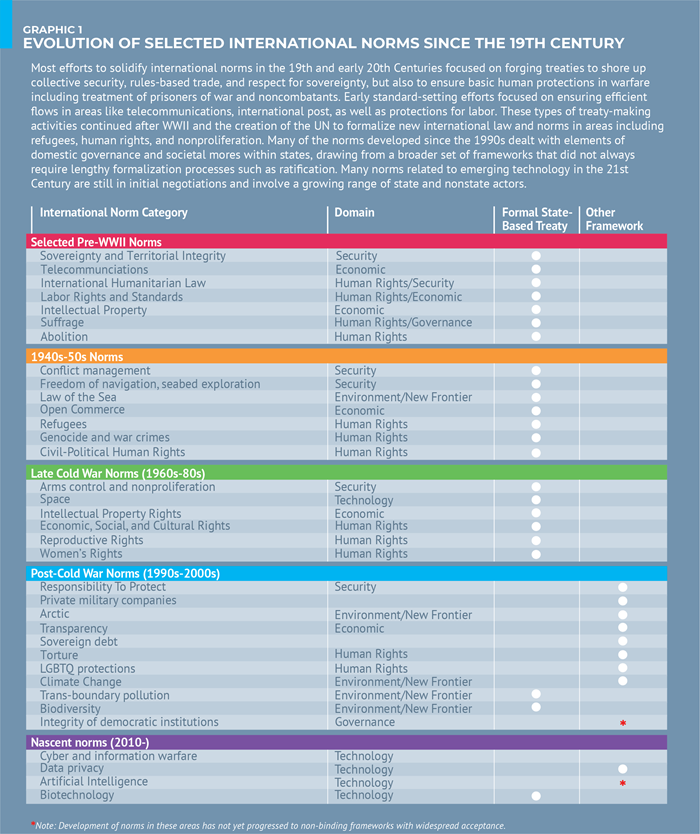
(Graphic 1: Evolution of Selected International Norms Since the 19th Century - Click image to enlarge)


BRIEF HISTORY OF INTERNATIONAL NORMS

Norms have been central to the study and conduct of international politics for millennia; Plato and Aristotle considered how morality and justice shaped leaders’ decisionmaking and polities’ behavior, while the Catholic Church devised extensive norms for the conduct of sovereigns throughout Christendom. The norms of state sovereignty and inviolability of borders enshrined in the UN Charter trace their roots back hundreds of years, and the more widely studied international norm-building efforts since the end of WWII built on decades of efforts related to slavery, suffrage, humanitarian protections, copyright, and labor rights. Formal international agreements codified in the 19th and 20th centuries on law of the sea and commerce date back to longstanding European laws and customs. In addition, modern information communications technology and e-commerce relies on technology and commerce standards that emerged in the 19th and 20th centuries related to telegraph, postal, and radio communications.

The adoption and entry into force of the UN Charter following the end of WWII set in motion a dramatic expansion in economic, security, and human rights norm-setting and codification of legal agreements. Western democracies led the establishment of an assortment of international institutions, alliances, and norms of behavior in diverse areas including collective security, individual civil and political rights, rules-based international trade and financial systems, and conduct in increasingly accessible physical domains such as the poles and outer space.

Many security norms were designed to prohibit the most destructive behaviors that contributed to the two world wars. For example, in the 1960s, the nuclear nonproliferation regime was intended to disincentivize any additional states beyond Permanent UN Security Council (UNSC) members from acquiring nuclear weapons, while the norm against acquiring new territories or resources by force sought to contain aggressive territorial expansion.

During the 1990s, a range of states and non-state organizations capitalized on the weakness of proponents of absolute state sovereignty principles, such as post-Soviet Russia, and took additional steps to formalize individual rights norms, which some states interpreted as restrictions on sovereignty. States and transnational networks also banned certain conventional weapons, including land mines, and defined states’ responsibility to protect their citizens and justify external intervention when states failed to protect their citizens and when authorized by the UNSC.

Some scholars suggest that moves to broaden the interpretation and application of certain human rights and humanitarian norms have energized a stronger and more organized backlash, both from governments and domestic groups in democracies. At the same time, authoritarian countries—namely China and Russia—have amassed more power and gained increased confidence to champion alternative norms on the international stage.


AUTHORITARIANS MORE AGGRESIVELY PUSHING THEIR VIEW OF NORMS

Authoritarian governments, particularly China and Russia, are selectively opposing and trying to roll back normative changes made since the 1990s, related to human rights and systems of governance to defend their legitimacy and promote their interests at home and abroad. Their sometimes distinct efforts emphasize non-interference in the internal affairs of countries, based on their definition of national sovereignty. Although they have had mixed success promulgating new agreements in formal multilateral negotiations, over time, the effect of their actions has been to chip away at the political human rights norms championed by democracies in recent decades, such as minority and LGBTQ rights, and provide legitimacy to repressive regimes worldwide.

China, Russia, and many states in the Middle East and Global South are rhetorically advocating strict adherence to the UN Charter’s prohibition on interference in the domestic affairs of sovereign states to enable their actions at home while leaving them room to disregard these restrictions in neighboring states.

  • China, Russia, and other authoritarian countries, such as Egypt, have cooperated to frame their domestic crackdowns and military campaigns as valid responses to terrorist threats, including those against Uyghurs, Chechens, or the Muslim Brotherhood.

  • China’s foreign and security policy continues to espouse non-intervention; however, Beijing has interfered in other states, notably by retaliating against those that are critical of China or that engage with Taiwan or the Dalai Lama. Western scholars argue that under President Xi Jinping, China has embraced more flexible and limited interpretations of non-intervention, to justify meddling in the internal affairs of neighboring states.

  • China is pushing its own definition of democracy and touting its “whole process democracy” as a more representative and effective model than the US system, including by hosting its own international democracy forum and releasing a white paper timed to the US Democracy Summit in December 2021.


China and Russia are also taking more direct and sometimes-coordinated action in international forums to undermine norms related to individual human rights and security, respectively. China is particularly focused on pushing back against efforts to advance individual human rights, whereas Russia is more focused on constraining the use of force by the United States and its allies.

  • China and Russia have attacked a range of Western-backed human rights norms at the UN, such as freedom of expression and LGBTQ rights. Russia condemns Western military interventions while defending its own interventions in Georgia, Libya, Syria, and Ukraine. It advocates collectivist economic and cultural rights and prioritizes states’ rights over individual political freedoms.

  • In the last five years, China and Russia have had more success weakening the mandates and institutional support for UN human rights country-specific monitoring mechanisms and accountability efforts than they had during the previous decade, judging from UN voting records and academics.


China and Russia are working closely to advance norms on emerging issues, such as cyber, space, and digital information, to promote their broader interests. China and Russia have won UN votes in support of some of their priorities, but their proposed norms most often fail to gain universal backing.

  • China and Russia have also used regional and UN forums to coordinate positions and promote alternative cyber and space norms proposals. These proposals seek to constrain freedom of speech online and centralize Internet governance under government control.

  • China and Russia insist that national governments have sole responsibility for deciding key policies that affect the information environment in their countries. Since 2018, Russia has used the UN “Open-Ended Working Group” to push its preferred norms on state control over information content as a universal cyber norm.

  • Since at least 2016, China has persistently inserted language on state sovereignty and control into negotiations regarding international development finance and Internet governance, while deemphasizing Western-favored norms on responsible lending practices and individual freedoms. China’s surveillance law frameworks and environmental and labor standards have been internalized through formal legislation in many Belt and Road Initiative (BRI) countries, and BRI investments by China-controlled entities often lack the conditionality of IMF and World Bank projects.

DEMOCRACIES IN A WEAKER POSITION TO DEFEND OR ADVANCE NORMS

Some democratic states that have long championed norms around individual rights and free trade are experiencing more internal debates and in some cases, growing opposition to the free flow of people and information. In recent years, many democracies have struggled with growing societal backlashes to influxes of migrants and refugees, amidst a backdrop of broader economic stagnation and intensified political polarization, much of which has been compounded by the COVID-19 pandemic.

  • This internal polarization has made it more difficult to forge multilateral political coalitions and for some states to continue to press traditional foreign policy priorities. For example, several European countries have experienced significant swings in foreign policy positions following elections or even government collapse, further complicating the task of building consensus for EU positions. At the same time, ethno-nationalism and identity politics have reshuffled traditional political parties in some countries.

  • Democracies with devolved or federalist governing structures, such as Australia, Brazil, India, and South Africa, have further complicated international norms and standard-setting efforts. Cities and other administrative units are championing their own standards and norms on issues ranging from energy efficiency and pollution to LGBTQ rights, often going beyond the national government’s positions and forcing courts to adjudicate.


Domestic clashes within democracies over issues such as pluralism and individual rights continue to seep into international discussions, and some disagreements have intensified because of emergency pandemic measures. Democracies are increasingly split over issues of state authorities and responsibilities, individual rights, and protections for marginalized groups, hampering consensus-building efforts in multilateral venues.

  • Human rights: Some democracies have reduced moral and material support for intergovernmental mechanisms such as the UN Human Rights Council (UNHRC), UN special rapporteurs, and the International Criminal Court. Critics have pointed to the UN’s continued poor record in addressing some of the most egregious human rights violations as well as the growing influence of authoritarian states, such as China, Russia, and Saudi Arabia. Western NGOs have documented decreased rhetorical commitment for human rights norms during the past several years among many states, including Western democracies.

  • Refugees: Many democracies have contravened the 1951 Refugee Convention by severely curtailing asylum rights and deporting refugees to countries where their safety is at risk. In addition, emergency pandemic measures have placed constraints on governments’ willingness to admit refugees.

  • Free trade: Certain WTO members have come under criticism from other states and businesses for undermining open commerce and rules-based trade regimes by using national security or COVID-19-related justifications to erect protectionist trade barriers that advantage domestic industries.


While non-democracies and non-state actors have often disagreed with or defied individual rights-based norms, challenges from groups within prominent democratic actors are a newer phenomenon and potentially more destabilizing. Consensus among and to some degree within Western democracies historically has been necessary to broker and institutionalize controversial norms.

  • Scholars argue that norms are more likely to decay when the international community fails to condemn violations than when violations are committed. Potential spoilers are encouraged when other norm breakers do not incur punishment or face marginalization.

  • Other states, such as Canada, Australia, and Norway, continue to try to defend and advance humanitarian and human rights norms outside the areas of migration, but their efforts have hit opposition in multilateral forums.

EU TRYING TO DEFEND OLD NORMS, ADVANCE PRIVACY NORMS

Some individual EU member states, such as Hungary and Poland, thwarted EU efforts in multilateral bodies to defend human rights; however, the EU as a whole continues to support individual rights and promote new initiatives, such as digital privacy regulations.

  • The EU actively champions more contested human rights norms on issues that include LGBTQ and gender equality. However, the EU has faced internal challenges since 2017 to condemning China's human rights practices because of objections from members that have strengthened economic ties with Beijing, such as Greece and Hungary.

  • In 2018, the EU started enforcing the Global Data Protection Regulation (GDPR), an effort dating back more than a decade to harmonize European data protection laws. GDPR has placed new obligations on companies, including the right to be forgotten, mandatory data breach notifications, and rules for storage and processing personal data. This regulation is being replicated across dozens of countries outside Europe, and studies have estimated that more than 60 percent of the world's population will fall under GDPR or similar tough data privacy laws in the future.

NONSTATE ACTORS AND SMALLER STATES TRYING TO DRIVE NORM-SETTING

Activists, NGOs, and smaller states are looking for ways to drive norms and fill gaps left by the perceived faltering by some democracies. Nonstate actors continue to contest the efficacy and legitimacy of international norms and institutions, often by building advocacy networks, harnessing technology, and working through state allies in key institutions. Some norms championed by nonstate actors conflict with the stated policy positions of the United States and its allies on topics such as nuclear disarmament, cybersecurity, climate change, and genetically modified organisms.

  • Arms Control: Building on past successful examples of pushing through treaties on landmines and cluster munitions, a coalition of NGOs and mostly small states pushed the Treaty on the Prohibition of Nuclear Weapons through the UN in 2017. The treaty, which entered into force in 2021, prohibits the possession, use, and threat of use of nuclear weapons. Working alongside leading state proponents Austria, Ireland, and Mexico, nonstate advocates used a majority-voting process to negotiate the treaty outside the UN’s main disarmament machinery, the Nuclear Non-Proliferation Treaty, and without support from nuclear weapons states.

  • NGOs have played an influential role in UN climate negotiations from the lead-up to the Paris Agreement in 2015 through the UN climate summit in Glasgow, Scotland, in late 2021. These organizations have lobbied state parties, advocated for action from sub-national levels of government, reported on negotiations, and monitored implementation. They have also implemented their own carbon reduction initiatives and pressed private companies to reduce emissions. Since 2015, however, many states have not provided details about how they will implement their commitments, and forging consensus on funding and verification has been difficult to achieve at UN climate meetings.

  • Activists opposed to genetically modified organism (GMO) food have organized protests across dozens of countries and complicated trade talks among the United States, EU, and other actors for decades.


In addition to civil society NGOs and small states, commercial actors and industry-affiliated NGOs are increasing their participation in international discussions about norms, practices, and standards—looking to protect their assets and goals.

  • Given slow movement toward voluntary norms and rules of conduct in cyberspace in formal UN discussions, private-sector actors and states such as France have proposed initiatives aimed at preventing attacks on critical infrastructure, improving cybersecurity, and reducing offensive operations in cyberspace. In 2018, France announced its Paris Call for Trust and Security in Cyberspace, which condemns malicious cyber activities during peacetime.

  • Governments, companies, and civil society organizations have worked together to promote multinational business codes of behavior. They have developed the Voluntary Principles on Security and Human Rights, the International Code of Conduct for private security companies, and the Global Network Initiative to encourage companies that have yet to sign onto these standards to adhere to international human rights, as well as environmental, and labor norms and standards. The UN’s endorsement in 2011 of the Guiding Principles on Business and Human Rights marked an important juncture in developing norms around business conduct, and this has been followed by calls for an enforceable treaty.

  • Industry-aligned groups, such as Global Climate Coalition and World Business Council on Sustainable development, have joined scientists and civil society organizations to convince states to expand their goals for cutting greenhouse gas emissions.
    Nonstate actors, including NGOs, some private companies, and professional organizations, have demonstrated sophistication in setting and implementing norms on issues such as technology and climate change. These actors can leverage existing networks and new digital media to shape public attitudes. They can also encourage private compliance by controlling access to their platforms and wielding their significant financial leverage. However, nonstate actors, with the exception of large multinational corporations, lack the tools to require compliance, and they most often are not monitored or accountable outside their own organizations.
  • Business and industry actors have the ability and incentive to influence technology and cyber norms because they produce content as well as software and hardware, own and operate critical Internet infrastructure, and are increasingly liable for cyber attacks against their clients. For example, technology companies can punish transgressions in real-time by enforcing Terms of Service agreements, or by naming and shaming violators.

  • Professional codes of ethics have shaped behavior and withstood some normative challenges in emerging areas such as biotechnology. For example, after a scientist in China, Dr. He Jiankui, modified the germ line in a pair of twins in 2018, he was nearly universally shunned by the global scientific community.

DEBATES ABOUT DRONES AND LETHAL AUTONOMOUS WEAPONS PORTEND FUTURE NORMATIVE CONTESTS

Advancements in war-fighting technology present new challenges to norms related to International Humanitarian Law because they can blur the roles of human choice and accountability. Al-powered autonomous weapons, still in early stages of development, have prompted concerns about violations of the laws governing warfare and what constitutes legitimate targeting, particularly because technology cannot be held accountable. Advances in drone technology and concerns about Al-powered autonomous weapons systems have prompted various state and human rights actors to seek to ban or develop standards and norms that would limit their use. These disagreements foreshadow potential fights to come over norms on other types of emerging technologies with security implications.

  • Ambivalence among some states and companies about prohibiting research into potentially useful military technology has helped stall progress on developing new norms; China, Israel, Russia, South Korea, and other advanced states are developing autonomous weapons systems.

  • The technology's proponents have argued that autonomous weapons may be more humane than human-controlled ones because they can employ the precise minimum amount of force necessary. Opponents have raised ethical concerns about whether autonomous weapons should be empowered with lethal decisions and argue it will not be possible to create an algorithm to anticipate all situations. An international campaign led by human rights NGOs and supported by dozens of states has called for creating an international treaty banning the development and manufacture of lethal autonomous weapons. Google in 2018 published guiding principles eschewing Al for use in weapons systems.

IMPLICATIONS OF A FRAGMENTED NORMATIVE ENVIRONMENT

During the coming decade, this diversified and competitive international environment will make it more challenging for many states to maintain commitments to existing norms, establish new norms, solve global challenges, and prevent escalatory behaviors.

  • Selective adherence to norms: The broader range of influential actors with divergent interests and goals will further complicate efforts to maintain and monitor commitments to many established international norms. Many contemporary and future challenges will require buy-in from individuals and organizations at all levels. Diminishing consensus among the major state powers is likely to make it more difficult to condemn or punish bad behavior. In this fragmented environment, states and nonstate actors are likely to see fewer risks in ignoring certain norms, leading some to opt out entirely selectively adhere, or offer alternative norms.

  • Difficult multilateral norm-setting in traditional venues: Establishing new norms to deal with longstanding or emerging issues will be more complicated and time consuming than it had been in previous eras because of competing normative visions and the lengthy negotiation process. More actors will have opportunities to block progress on rivals’ norms, undercut enforcement for violations, or use sabotage or disinformation campaigns. Treaty- making declined precipitously during the last decade compared with previous decades, judging from international legal periodicals, even as new technological developments and environmental challenges accelerated.

  • Fragmenting to localized or regional norms: Some actors will work to shift norms-setting discussions away from the consensus-based intergovernmental institutions to majority-vote formats, or alternatively to regional or nonstate actor-led organizations. In some cases, negotiations on treaties will remain within UN architectures but take place in intergovernmental working groups where a self-selected group of actors controls the agenda. These forums could develop normative frameworks that bear the UN imprimatur while competing with or contradicting existing architectures, potentially undermining the effectiveness of international norms. If norms become more localized for regions or self-defined groups of countries, conducting business and ensuring compliance with future agreements will become even more difficult. Alternatively, norm discussions that begin at the regional level or among affinity groups of actors can serve as the catalyst for broader international negotiations, such as occurred with negotiation processes for the Antarctic and Nuclear Non-Proliferation treaties.

  • Less collective action on global challenges: Eroding consensus among certain governments and political factions on the need to respect certain foundational principles will complicate or even stymie international cooperation on global challenges, such as mitigating climate change, dealing with refugees and migrants, minimizing risks from new technologies such as AI and biotechnology, and combating future pandemics. Cooperation in a fractured normative environment is more likely to occur within certain ideologically or regionally defined groups, which could help coalesce action to challenges at lower levels, but will prevent nations from mustering effective responses at the global level.

  • Greater risk of confrontation: Declining adherence among some countries to norms on non-violability of borders, assassination, and use of certain weapons systems––in part because of advances in cyber, robotics, AI, and space technology––will increase the risk of miscalculation and conflict. Some of these technologies, if they remain outside normative frameworks, will raise uncertainty among policymakers and make it more likely they will take preemptive action. The availability of these technologies to nonstate actors will also raise the threats to states and risk drawing them into conflicts not of their choosing.


Major powers are still likely to seek to cooperate and uphold norms in mutually beneficial areas, even in an increasingly competitive environment. China and the United States, for example, will still share an interest in preventing further nuclear proliferation in East Asia and the Middle East, containing conflict escalation between nuclear-armed India and Pakistan, preventing global financial crises, containing future infectious disease outbreaks, and avoiding collisions in space. The norms that emerge may be less institutionalized than during the Cold War, but they could still serve as useful checks on risky behavior and help reign-in actions by allies or proxies that threaten to draw the great powers into a broader conflict.

Nonstate actors, along with a handful of key innovative economies, probably will have greater ability to establish norms on emerging technologies than in previous decades, as the pace of innovation and development outstrips most states’ ability to keep pace with new normative and regulatory structures. However, their ability to enforce compliance is likely to remain limited.


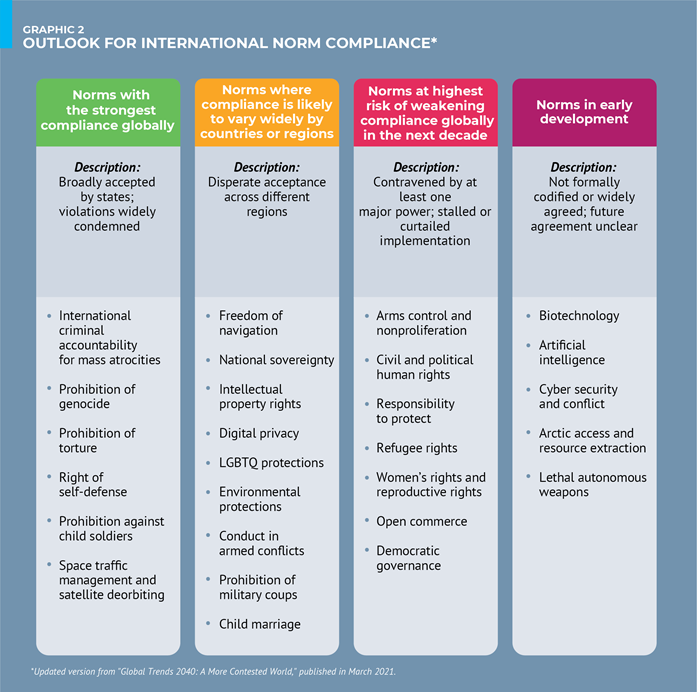
(Graphic 2: Outlook for International Norm Compliance - Click image to enlarge)


ALTERNATIVE NORMATIVE FUTURES

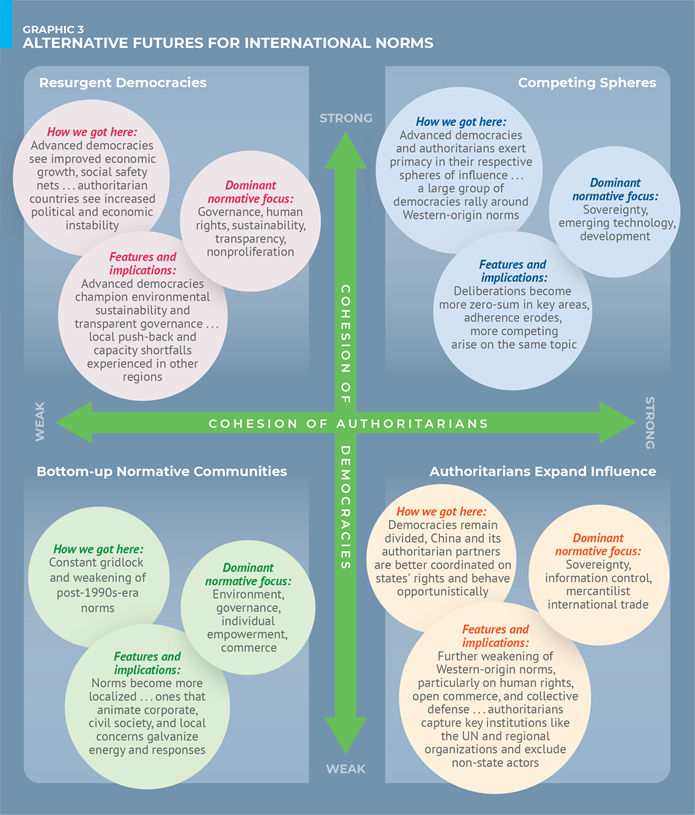
Over the long term, the future of international norms will depend heavily on the state of geopolitical competition, technological advancements, and societal dynamics. In the following table, we identified four scenarios for how norms could unfold during the next decade, focused on the interactions of democratic and authoritarian powers in the international system. Certain international norms may fall into some or all of these scenarios depending on the norm in question and dynamics among states. For example, human rights and national sovereignty in the information space are more likely to exist in bipolar, competing structures, whereas norms related to the climate and environment are more conducive to bottom-up community approaches.


(Graphic 3: Alternative Futures for International Norms - Click image to enlarge)

DEEPER LOOKS

Technology and the Future of Work PDF Version - Download

This paper was produced by the National Intelligence Council’s Strategic Futures Group in consultation with outside experts and Intelligence Community analysts to help inform the integrated Global Trends product, which published in March 2021. However, the analysis does not reflect official US Government policy, the breadth of intelligence sources, or the full range of perspectives within the US Intelligence Community.

During the next two decades, technological innovations—including automation, online collaboration tools, artificial intelligence, and additive manufacturing—will reshape some fundamental aspects of how and where people work. The future workplace is likely to be increasingly flexible but also increasingly insecure as companies demand new skill sets while no longer providing employees with traditional benefits. A key uncertainty is whether the labor force will adjust quickly enough to meet the demands of the new working world. Scholars agree that although technological innovations will eliminate many jobs, they will also create new ones as firms shift labor into complementary tasks. However, the skills required and the locations of these jobs may not match the capabilities of the labor force—putting pressure on already stretched governments to help labor markets manage these new conditions.


TECHNOLOGY DRIVING WORKPLACE CHANGES


New technologies are reshaping the workplace through automation, online collaboration tools, artificial intelligence, and additive manufacturing. Tasks that once seemed uniquely suited to human abilities, such as driving a car or diagnosing a disease, are already automated or potentially amenable to automation in the next decade. Emerging technologies are also making possible virtual labor mobility through Internet-based freelance platforms that match customers with self-employed service providers, as well as speed-of-light commercial data and software transmission.

Automation Continuing To Replace Some Jobs

In advanced economies, robots are increasingly supplanting humans for routine tasks and may take on more complex tasks in the coming decades as progress is made in artificial intelligence (AI). Companies probably will apply AI breakthroughs in object recognition, machine translation, robotic controls, and natural language processing as a labor-saving measure in white-collar professions.

  • Automation is most widespread in jobs with midlevel technical skill requirements. However, employees with nonroutine skills that complement automated processes are in high demand and have seen rising wages. These nonroutine skills include emotional intelligence and teamwork, as well as critical thinking and problem solving skills.

  • In the coming years, AI is likely to be applied to higher skill tasks, eliminating some jobs while significantly increasing the productivity of those workers who remain. Affected fields include law, medicine, finance, and software development. Lab technicians, chemical engineers, and optometrists are examples of professions particularly vulnerable to future AI applications.


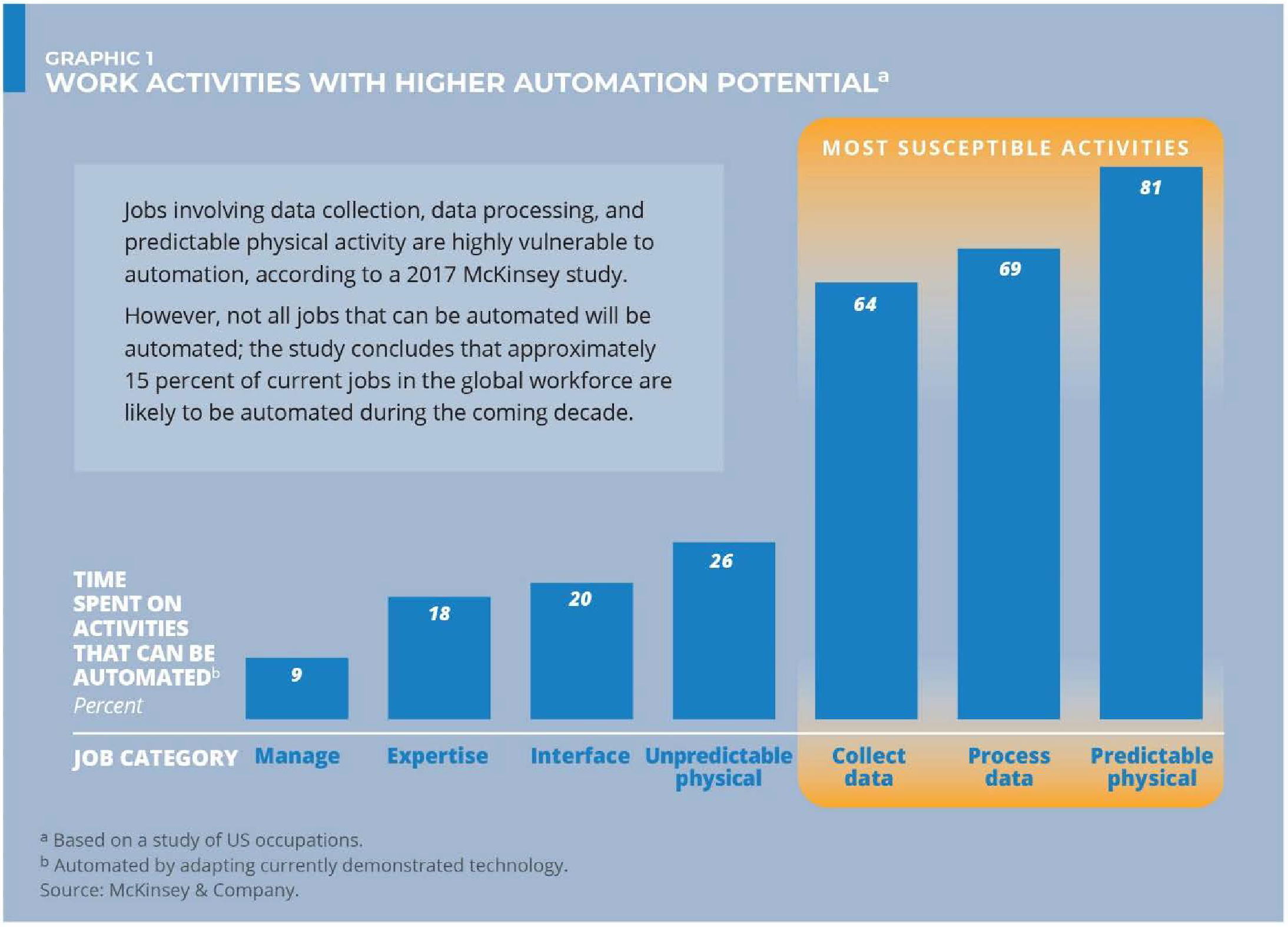
(Graphic 1: WORK ACTIVITIES WITH HIGHER AUTOMATION POTENTIAL - Click image to enlarge)


PREVIOUS WAVES OF WORKPLACE DISRUPTION

Changes to work in the coming two decades will probably reflect aspects of previous waves of job market change, from the 19th century Industrial Revolution to the automation and trade globalization of recent decades. In those episodes, shifts in technology and the workforce created winners and losers, with worker skills, retraining opportunities, and the government role in labor market adjustments showing up as common denominators.

  • Industrial Revolution. Beginning in the late 18th century, as the European population boomed, Western economies underwent massive shifts in the workforce out of agriculture and into industrial jobs. New technologies drove productivity in the agriculture, iron, and textile sectors. The adaptation of coal-powered steam engines to railroads and shipping boosted international trade. Over a period of several decades, the Industrial Revolution was especially difficult for low-skill-worker households, as wages failed to keep up with the cost of living. Many poor households lived in unhealthy conditions, with inadequate food, housing, education, and social services.

  • Rising Labor Share. Technology and workforce changes can lead to improvements for workers, too. In the wake of World War II, several factors common to most advanced economies combined to shift firm profits away from business owners and to workers, thereby reducing income inequality. These included widespread education, worker unionization and other types of political power, demands from aging workers for retirement benefits, factory mechanization that improved the productivity of low-skill workers, and a cultural shift that emphasized the social benefits of lower income inequality.

  • Outsourced Manufacturing. When China joined the global trading system in the early 2000s, it was home to almost one-quarter of the world's total working-age population. Chinese manufacturing wages were as low as 3 percent of those in the United States, giving China a labor cost advantage that helped drive its rapid increase in global market share, in combination with effective use of imported technology. Western manufacturers took advantage of the cost savings and moved many factories overseas, leading to significant job losses in certain regions of advanced economies, disrupting local communities.


An automation wave is likely to hit some developing economies during the next two decades, although their current automation levels are lower than those of advanced economies. The cost of automation and digital technology continues to decline globally, reducing barriers to new investment in robots. Developing economies with workforces that probably are vulnerable to disruptive automation include Brazil, Costa Rica, Malaysia, Romania, and Russia because their working populations are older and they earn relatively high wages.

  • Some developing economies will struggle to industrialize as automation reduces the cost of manufacturing elsewhere. For example, as Asian manufacturers adopt automation and other innovative technologies, they will gain cost advantages derived from producing large volumes of goods. Exports of these products will drive down the prices of competing goods globally, making it difficult for small-scale manufacturers in Latin America and Sub-Saharan Africa to compete in the marketplace and reducing the number of industrial jobs in those regions. Instead, employment in those regions has been gravitating toward the lower paying services sector.


A key uncertainty about automation during the next few decades will be the degree of its disruptive effect on labor markets. Automation could create such efficiency that the number of well-paid jobs created is less than the number lost. Whether workers and companies will be able to meet retraining and education needs is unclear, given the pace of change. One 2013 study concluded that up to half of all US jobs were susceptible to being overtaken by the new forms of automation. More recent studies have looked closely at which job subtasks are automatable and found a smaller percentage of jobs at risk. The newer results concluded that 9 percent to 15 percent of jobs on average could be displaced—still highly disruptive, but on a scale that may permit workers, companies, and governments time to adapt without being overwhelmed.

FROM FACTORY-FREE PRODUCTION TO OFFICE-FREE SERVICES


How far could the disruption of services sector employment by international digitalized services platforms spread? The path charted by some manufacturers over the past two decades suggests that the answer is "very far". Some manufacturers went to the logical extreme of outsourcing all production in what became known as "factory-free production"-for example, Apple-designed iPhones are assembled in Asia, and Dyson designs vacuum cleaners but subcontracts out the production.

This development could point the way to a large-scale "office-free services" model, with major corporations operating with no in-house human resources staff or international financial services firms with no physical headquarters.


(Graphic 2: THE FUTURE OF WORK IN SERVICES - Click image to enlarge)

Technologies Changing Where Jobs Are Performed

Companies are increasingly dividing jobs into discrete tasks that can be completed by teleworking employees or outsourced to sometimes geographically distant freelancers, further disconnecting work tasks from where those tasks are performed. Digitalization and Internet connectivity have facilitated this trend with innovations such as online document sharing, cloud storage, wireless connectivity, videoconferencing, and AI-augmented process management. During the next 20 years, advances in telepresence technologies, such as virtual reality, will allow more physical tasks to be completed remotely, expanding this trend beyond traditional office jobs.

  • Long before we began to experience the workplace disruptions caused by the COVID-19 pandemic, more than 2 million additional US workers had begun working from home at least part-time, bringing the total to 8 million US workers, according to US Census Bureau estimates, or more than 5 percent of the US workforce. Similar percentages of workers have reported working from home in Europe and Japan.

  • Freelancing or “gig economy” web platforms facilitate outsourcing of office tasks, such as web development, writing and translation, design and multimedia, and administrative support, as well as consumer services such as ride-sharing, delivery, and household microtasks.

  • Technological advances almost certainly will reshape more traditionally physical jobs as well, in industries such as mining, forestry, and oil and gas. Automated techniques allow for operations control or infrastructure inspection by remote workers who could “visit” multiple geographically distant sites in one day. Self-driving vehicles, drones, and other robotics are likely to accelerate this trend.


Parallel with the rise of offsite work within countries, companies in advanced economies are increasingly sourcing services to workers in emerging economies, particularly those in East and South Asia and Sub-Saharan Africa. International trade in digitally deliverable services—including financial and business services and computer programming—has grown at almost twice the rate of the global economy during the past 15 years and in 2018, contributed more than 3.5 percent of global economic output, double the value of international tourism that year.

  • Workers in developing Asian countries are benefiting from new employment in cross-border freelanced services, such as software development and IT systems integration, but these freelancers receive relatively low average wages and have poor labor bargaining power.

  • Three developing countries are among the top 10 countries with the largest share of digitally deliverable services in their total service exports: Sierra Leone (76 percent), Ghana (73 percent), and India (66 percent).

  • Freelancers in Kenya are among the leading suppliers of writing and translation services globally, and in Nigeria, South Africa, Tanzania, and Zimbabwe, freelancers are among the most active in supplying software development services.


Additive manufacturing—known as 3D printing—is also changing the location and composition of jobs as companies “reshore,” or localize, production plants. Additive manufacturing offers companies several advantages, such as the ability to make lighter weight parts, avoid wasting material, and save on shipping costs. The widespread adoption of this technology could eliminate manufacturing jobs in some emerging economies while creating new jobs in advanced economies in product design, customer relations, and computer programming.

  • Many jobs associated with additive manufacturing offer higher pay and demand greater skill than traditional manufacturing jobs, but such jobs are also scarcer. For instance, software engineers are needed to modify the 3D printer computer code when a product is customized.

  • The medical device industry has already widely adopted additive manufacturing, a trend probably accelerated by the COVID-19 pandemic because the health care industry has worked to quickly leverage 3D printing for ventilator valve and personal protective equipment production. The automotive and aerospace manufacturing sectors are among those likely to generate the greatest number of 3D printing tasks.


DEMOGRAPHICS, PANDEMIC ACCELERATING NEW WORK PRACTICES


Aging Workforces Spurring Automation

During the next two decades, the workforces of most of today’s largest economies will shrink as aging workers retire, increasing the need for automated processes. South Korea will lose 23 percent of its working-age population (ages 15-64), Japan 19 percent, Germany 13 percent, and China 11 percent, according to UN projections. Southern Europe’s advanced economies—such as Italy, Portugal, and Spain—make up the world’s most rapidly aging region; together their working-age populations will decline by more than 17 percent during the next 20 years.

Automation—traditional industrial robots and AI-powered task automation—almost certainly will spread quickly as companies look for ways to replace and augment an aging workforce. Companies with large cohorts of workers 55 and older are more likely to adopt robotics and other forms of automation as they anticipate the potential for declining workforce productivity. Industrial robots are currently concentrated in the United States, China, Germany, Japan, and South Korea, only one of which—the United States—does not have a shrinking workforce.

  • Southern and East European economies probably will adopt more workplace automation, given the anticipated high rates of worker retirements. In particular, Italy, Russia, and Spain have lower-than-average rates of industrial robot adoption, suggesting that increased automation could spread to those countries.

  • Automation and AI will also be adapted for aging workers in white-collar workplaces. For example, networked and smart hearing aids could enhance communication, and robotic exoskeletons could increase personal mobility.


Pandemic Response Leading to New Ways, Locations for Working

In response to the coronavirus pandemic, companies worldwide have quickly expanded technology-driven workplace changes. Some companies have encouraged employees to work remotely rather than commute to worksites, and many businesses have shifted to digitally connected virtual teams, eliminating the need for business travel. Although some of these changes are likely to remain after the pandemic ends, others may be discontinued if companies and workers decide in-person engagement is critical to performance.

  • Videoconferencing is replacing daily commutes to an office and periodic travel for conferences. As quarantine measures were widely implemented in March 2020, office videoconferencing apps saw record downloads by users in Italy and Spain—countries that previously had below-EU-average rates of work from home. Traffic on one videoconferencing app rose from 10 million daily meeting participants in December 2019 to more than 300 million in April 2020.

  • For office workers already struggling with the high cost of housing in urban centers, temporary remote work protocols have raised interest in permanently working remotely from lower cost locations. When the COVID-19 crisis has ended, employers are likely to maintain larger percentages of remote and freelance workers, even while potentially facing questions related to adjusted pay scales, and mechanisms for employee monitoring and feedback.


Technology is also filling and creating new roles in the services sector, in particular where the public is demanding a shift to low contact or automated options. For example, online streaming of entertainment is eliminating jobs in movie theaters and live performance venues while digital platforms are creating new job opportunities in shopping and delivery services.

  • Many countries are testing robots and drones—including the United States, Chile, China, Ghana, Israel, and South Korea—to replace humans in high-contact tasks, such as medical testing, surface sterilization, and package delivery.

  • Even in industries where telework is not an option—such as manufacturing, farming, and food processing—companies probably will pursue technological fixes to keep their businesses operating with fewer workers. As in previous crises, companies have been making capital investments in automation, which is likely to accelerate the trend in some industries.

BROADER IMPLICATIONS


The changing landscape of work raises broader implications, especially for advanced economies, concerning social stability and the role of governments on issues of inequality, social identity, and regulation.

Increasing Inequality

The hollowing out of the middle-income workforce in advanced economies—a process under way for the past two decades—almost certainly will continue, with profits disproportionately going to some high-skill workers and the corporations that hold the new technologies. Automation has replaced mostly middle-skill jobs even as employers add workers at both the bottom and top of the pay scale—a trend known as “job polarization.”

For example, across Western Europe and the United States, the employment share for traditional middle-income jobs, such as machine operators, metalworkers, and office clerks is decreasing. At the same time, low-paying services-sector jobs, such as sales representatives, as well as high-income jobs for doctors, engineers, and other professionals are increasing.

Overall compensation for workers relative to economic output probably will also shrink during the coming two decades. Automation has decreased the overall share of worker take-home pay relative to corporate shareholder profits because decreases in wages and jobs displacement have not been fully offset by the potential of automation to produce more goods and drive new employment in related industries.

  • Although many new high paying, high-skill jobs have been created in the past 20 years, the total wages and benefits those workers earn do not surpass the lost wages and benefits of the displaced workers.

  • In the years ahead, some higher skill professionals are likely to face declining wages as new technologies begin to supplant the routine tasks they perform—a development that will further contribute to downward pressure on worker pay.


Digital freelance, or “gig economy,” platforms are contributing to declining aggregate worker earnings and benefits in advanced economies, since most freelancers work part-time and have lower-than-average overall take-home pay. As remote work becomes more common, companies may increasingly substitute freelancing for work performed offsite by employees as a cost-saving measure.

  • Freelancers, who do not receive employer-provided benefits, are more vulnerable to employment loss during a business downturn. Payment is also more at risk for freelancers. At some point, about 90 percent of freelancers have been denied payment after completing a task based on what the customer claims—often unfairly, according to freelancers—is subpar work.


Even though aggregate wages probably will fall in advanced economies, a small portion of workers will see rising wages and profits. Technology innovators and workers who perform nonroutine and cognitive work that is enhanced—not replaced—by automation almost certainly will continue to see their wages increase relative to those of other workers. Overall worker compensation will further concentrate in key digital domains affected by automation, such as online search, electronic communication, and online shopping.

  • A handful of companies enjoy near-monopolies in these domains, benefiting from network effects inherent in digital services. That is, the larger the user base of these digital services grows, the more desirable these companies’ services are to consumers, even though the marginal cost of expanding their services is close to zero. Consequently, workers in jobs with access to these monopoly profits will see higher wage growth.


The pandemic is accelerating this trend as consumers avoid brick-and-mortar stores and companies shift to e-commerce and work-from-home arrangements, giving online platforms additional market share. Although consumers probably will revert to their pre-pandemic lifestyles after the pandemic, surging shares of e-commerce companies in China, Europe, India, and the United States suggest that investors judge a substantial portion of the behavioral shift is likely to stick.

The need for retraining, particularly among lower and middle-income workers, could exacerbate income inequality, particularly if workers bear the burden individually. Low-income workers are likely to be unable to afford the certification necessary to obtain higher paid employment and thus be relegated to low-skill jobs. In addition, workers who are retraining could lack information on which training programs will pay off with future work assignments, exacerbating the skills mismatch that already leaves higher skilled positions unfilled.

Reshaping Social Identities

Changes to the nature, location, and compensation structure of work in advanced economies during the next two decades will further reshape white-collar workers’ social identities. Many people gain self-worth from their work and tend to identify closely with their workplace goals. Physical workplaces provide social cohesion and help build institutional trust in modern society. Changes and dislocations that many blue-collar and manufacturing workers in advanced economies experienced in the late 1990s will increasingly affect white-collar and service workers as companies begin disaggregating, outsourcing, and automating knowledge-worker jobs.

  • At the same time, many younger workers in advanced economies are eager to adopt more flexible and creative employment opportunities offered by workplace changes. Technology is enabling work to be more about tasks and less about job positions, allowing workers more choice on how and where to complete the tasks. Research shows that those who choose flexible working arrangements out of preference, not necessity, are positive about future changes to the workplace.

  • Polling in advanced economies during the past decade has shown that rising generations are less attached to institutional corporate structures and more eager to control their work. Similarly, younger business owners and hiring managers are more likely to allow nontraditional workplace practices, according to a survey of US firms.

  • Even so, many younger workers also experience anxiety and depression because of the less stable nature of gig or freelance work. A 2018 survey of Canadian millennials found that those with precarious employment—defined as permanent part-time work without traditional benefits—experienced a significantly higher prevalence of mental health concerns.


With automation poised to command a larger share of routine physical and cognitive tasks, workers will be expected to innovate, facilitate teamwork, and apply skills across different classes of tasks. Solutions to problems will be more readily crowdsourced—a method that is often more effective than relying on deep expertise alone.

  • To succeed, workers will need to continually acquire new skills, including using insights from real-time data analytics that artificial intelligence can generate from increasingly digitized homes and workplaces.


New Issues for Governments To Manage

As these trends unfold, the public is likely to increasingly demand that governments manage the dislocations caused by new technologies. Governments probably will have an incentive to play a role in managing and smoothing labor market disruptions, but many governments may not have the capacity to manage these issues when faced with a host of other challenges.

  • Governments most likely will face tough choices between investing in the current workforce and providing benefits to displaced and aging workers. Record levels of government debt in both advanced and developing economies, along with the rising overall costs of aging populations, could limit new programs for reskilling, healthcare, and retirement. Even in Sub-Saharan countries on the verge of a youth bulge, large older worker cohorts nearing retirement probably will strain the minimal elder care programs in place. In the long term, if governments neglect education and infrastructure, growth probably will slow.

  • Governments will have a regulatory and legal role in defining relations between workers and employers. The new work landscape may include today’s problems of bad business practices, gender and race discrimination, and fraud, as well as new types of bias in online “gig worker” employment platforms.

  • The growing trend of cross-border freelancing may require new regulatory frameworks, within and among states. Online freelancers may be vulnerable to cyber fraud, cyber attacks, and outages that have the potential to damage their livelihoods and, in aggregate, the broader economy. For instance, cryptocurrencies could become digital services workers’ preferred channel for payment, but in the event of financial system stress, cryptocurrencies may not have the backing of central banks, leaving online workers at greater risk.

  • The current era of deceptive digital material—including manipulated images—and cyber hacking will challenge freelance employment platforms to maintain credibility with their remote workforces. The problems could range from digital reputation manipulation and large-scale theft of other employees’ work to the possible macroeconomic disruption of core digital-economy platforms being taken offline through malice or natural disaster. These types of potential market failures in the nonvirtual economy are often the subject of government regulation.
DEEPER LOOKS

The Future of Water:
Water Insecurity Threatening Global Economic Growth, Political Stability PDF Version - Download

This paper was produced by the National Intelligence Council’s Strategic Futures Group in consultation with outside experts and Intelligence Community analysts to help inform the integrated Global Trends product, which published in March 2021. However, the analysis does not reflect official US Government policy, the breadth of intelligence sources, or the full range of perspectives within the US Intelligence Community.

Governments, industry, and civil society will face an increasing risk of water insecurity during the next two decades as demand grows and supply is increasingly strained. Moreover, poor governance and resource management, development practices, agriculture, and environmental degradation are also likely to diminish the quantity and quality of water supplies in many parts of the world. While developing countries will continue to experience more acute and pervasive water insecurity, some developed countries will also face strains on their water supplies. Countries that are unable to address water-related challenges probably will face a confluence of challenges, including greater risk of disease, growing inequality, poor economic growth, and a heightened risk of internal political instability. Shared water resources among states are increasingly likely to become flashpoints as water security diminishes and geopolitical competition grows.

MISMATCH BETWEEN SUPPLY AND DEMAND


Population growth, lifestyle changes, development, and agricultural practices will contribute to an increasing demand for water during the next 20 years. Global water use is likely to increase by 20 to 50 percent above current levels by 2050, with industrial and domestic sectors growing at the fastest pace. Agriculture will remain the largest overall consumer of water, but the relative increase to 2050 is likely to be smaller than other sectors.

  • As states’ economies grow and people move up the income ladder, their lifestyles often become more water intensive. This trend will occur predominantly through indirect means, such as greater consumption of water intensive foods such as meat, as well as through increased demand for goods that require large quantities of water to produce, such as cars, electronics, clothing, and larger homes.

  • Average groundwater use per person probably will increase during the next 20 years. In large parts of the Middle East and South Asia, as well as in Beijing and Mexico City, groundwater is the primary source of water, but years of overexploitation, pollution, and utilization of non-renewable fossil aquifers have severely degraded and reduced the supplies, in some cases irreversibly.

  • In many parts of the world, populations already face water insecurity—defined as the availability of an acceptable quantity and quality of water for health, livelihoods, ecosystems, and production. Each year, at least four billion people, nearly half in China and India, experience severe water scarcity for at least one month of the year. Nearly 500 million people are exposed to water scarcity all year long. As of 2020, about 2.1 billion people worldwide lack access to safe drinking water or reliable water service.


Development Practices. Many industrial and infrastructure development practices, including overuse of groundwater, surface water diversions, large dams, unregulated mining and extractive industries, and urban development without adequate sanitation, erode water security by reducing soil capacity to store water, thereby decreasing groundwater recharge, and increasing evaporation, erosion, and pollution. Globally about 80 percent of industrial and municipal wastewaters are discharged untreated into waterways that communities use for drinking, bathing, and agriculture. Groundwater pollution is of particular concern as contaminants move more slowly through groundwater than surface water, sometimes taking years or decades to affect water quality.

  • In megacities such as Dhaka, Karachi, and Lagos, poor sanitation and waste management practices will increasingly strain water supplies in the next two decades. Lagos, for example, has 200 informal settlements, and 80 percent of residents rely on private water boreholes, increasing the risk of sewage contamination or water supplies.

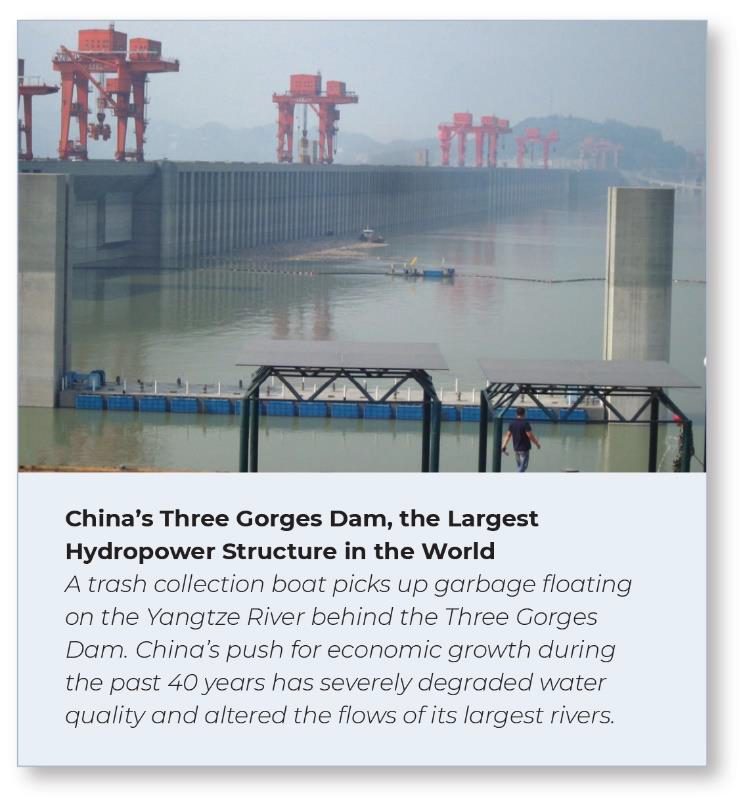
  • About 3,700 large hydropower dams are planned or under construction worldwide, primarily in Africa and Asia, according to Western academic reporting. These structures often lack careful design, regulation, and management, causing long-term water security problems, such as fragmentation of river systems, damage to fisheries and aquatic ecosystems, increased riverbank and coastal erosion, disruption and flooding of local communities, and decreased water quality.


(Graphic 1: China's Three Gorges Dam, the Largest Hydropower Structure in the World - Click image to enlarge)


Agricultural Practices.
Global water demand for agriculture—the single largest consumer of water—is projected to increase by 19 percent from current levels by 2050. By 2040, about 40 percent of all irrigated agriculture is expected to face extremely high water stress.

  • Irrigation and planting practices are often inefficient and unsustainable; globally about half of the water withdrawn for irrigation does not reach the intended crops or is oversupplied through practices such as flood irrigation and does not result in crop production. In addition, poor soil and planting or other agriculture techniques such as tilling, reduce water infiltration into the ground and increase evaporation.

  • Agricultural wastewater runoff is the most prevalent global water quality challenge. The discharge of large quantities of nitrogen and phosphorus into waterways promotes toxic algal blooms and reduces oxygen, causing die-offs of fish and other aquatic organisms.


(Graphic 2: Abandoned Fishing Boats Along Former Coast of the Aral Sea - Click image to enlarge)


Environmental Degradation and Climate.
Anthropogenic degradation of landscapes and waterscapes as well as climate change are affecting the quantity, quality, and timing of water supplies. Natural land, water, and climate systems are a complex, interdependent network, such that a change in one system can have wide ranging and unintended consequences in the others.

  • On average, about 40 percent of all rainfall over land originates from local plant transpiration and evaporation, although the percentage is much higher in some regions. Degraded landscapes that change plant composition or density can have significant impacts on local weather and water availability.

  • Multiple climate models and weather observations indicate increasing variability, intensity, and occurrence of droughts and floods over the next several decades. Rainfall almost certainly will decline in mid-latitude regions, and all areas are expected to have higher evaporation rates because of rising temperatures, increasing demand for water for irrigation. At the same time, increased energy and water in the atmosphere is increasing the likelihood of extreme storms and other weather phenomenon.

WEAK GOVERNANCE ENABLING MISMATCH


In many countries, ineffective governance and policies fail to address—and frequently enable—the mismatch between water demand and supply. Corruption and a lack of trust in governing institutions, low prioritization of water issues, and minimal coordination among government entities, the private sector, and civil society all contribute to this mismatch.

Corruption and Trust. Government corruption in the water sector often hinders full and fair enforcement of laws and regulations, diverts money from the development or maintenance of water projects, causes inequities in water distribution, and inflates costs. Corrupt governments frequently invest in large water infrastructure projects, including dams, because they are easy to skim from and offer political as well as economic returns.

  • Brazil’s "Operation Car Wash" scandal that began in 2014 revealed corruption related to the awarding of construction contracts, including several mega-dams in the Amazon River Basin. The consortium behind one dam was investigated for paying millions of dollars in bribes to the ruling party at the time to secure the concession. This dam destroyed hundreds of square miles of rain forest and crop lands, displacing at least 20,000 people.


Prioritization and Blame Deflection.
Many governments consider water governance and management a lower level priority, including in some wealthy, technically savvy countries. Water regulation in some cases is buried in uninfluential ministries or agencies or is relegated as a secondary resource that is managed in a piecemeal manner from other government bodies. In some countries, it is separated from the management and governance of other sectors, including agriculture, energy, and industry, despite water being a critical resource for all of those activities.

Governments at times have both ignored, or inappropriately invoked climate change or the actions of upstream countries as the primary cause of water insecurity, usually to cover for the failures of environmental governance or to gain or maintain a position of power in a shared water basin.

  • In Iran, the government and local scientists have blamed the extensive shrinkage of Lake Urmia in the country’s far northwest solely on climate change. Academic research, however, indicates that the nearly tripling of water consumption for irrigation in the basin since the 1980s, the lack of enforced water regulation and environmental laws, and limited wastewater treatment were the main causes of the lake’s decline.


Coordination.
Lack of coordination among government agencies, the private sector, and civil society frequently leads to mismanagement and the over-allocation of water resources. The interdependencies among water, energy, and food are often not recognized in water governance and management. Most notably, energy, agriculture, and water agencies often do not coordinate water use or water regulations, even when they draw water from the same source. In addition, inadequate monitoring, data collection, and data sharing frequently hinder a government’s ability to manage water resources effectively and efficiently.


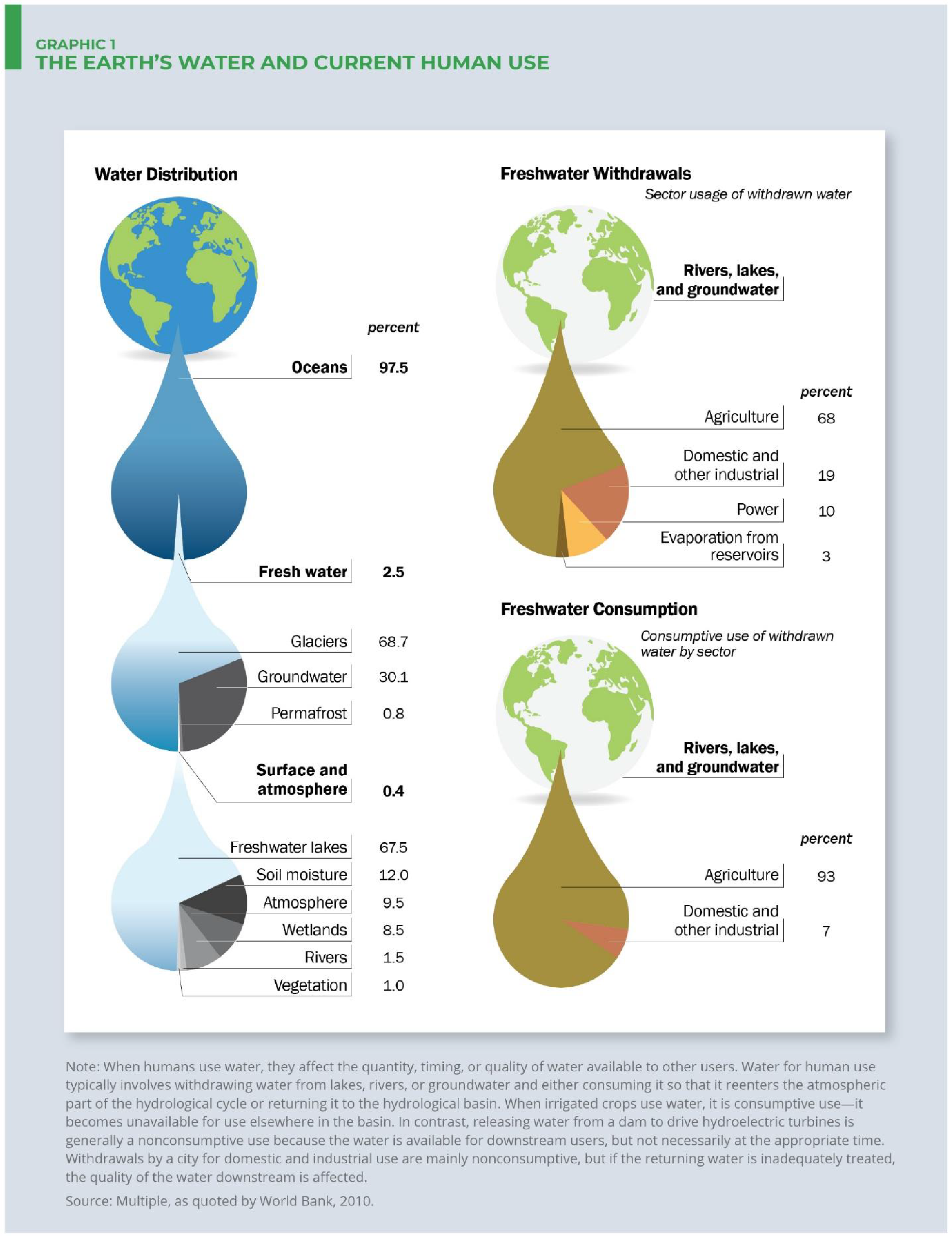
(Graphic 3: THE EARTH'S WATER AND CURRENT HUMAN USE - Click image to enlarge)


DEVELOPING COUNTRIES VULNERABLE BUT DEVELOPED COUNTRIES NOT IMMUNE


Developing and emerging economies will be most vulnerable to water security risks during the next 20 years, given their naturally complex, variable, and hazardous hydrography and their governance shortcomings. According to the World Bank, if current poor water management policies continue, by 2040 water security will decline in many areas that are not naturally water scarce—such as parts of Central Africa, East and Southeast Asia, and Latin America—and water security will further deteriorate in areas where water resources are naturally in short supply—including large stretches of the Middle East, North Africa, and the Sahel.

  • Most Middle East and North African countries are likely to see continued steep declines in their overall water security because of ongoing conflicts, weak or corrupt governments, increasing demand, high levels of pollution, unsustainable ground and surface water use, and natural water scarcity. Countries of particular concern include Egypt, Iraq, Iran, Jordan, Libya, Syria, and Yemen. In addition, many of these countries—including those in the Jordan, Nile, and Tigris River Basins—have ongoing transboundary water disputes with neighbors, potentially further complicating and reducing their ability to more effectively and sustainably manage water resources. Parts of southern Africa, the Sahel, and Horn regions are likely to continue to have high levels of water insecurity, especially the Lake Chad and Nile River Basins, and parts of Mali, Mozambique, Nigeria, Somalia, coastal South Africa, and the Sudans.

  • Many countries in South and Central Asia and parts of Southeast Asia are also likely to face declining water security because of corruption, unenforced or poor environmental laws, high levels of pollution, environmentally degrading development, transboundary or internal water disputes, and growing water demand from agriculture, textiles, and fishing. Geopolitical tensions could strain existing water-sharing agreements or prevent future cooperation.

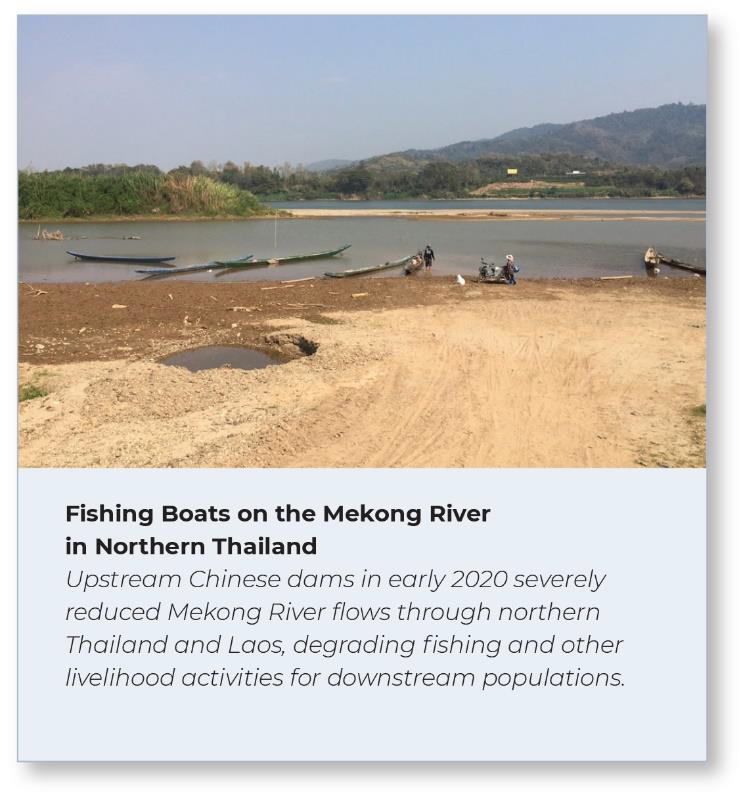
  • China, especially the northern region around Beijing and along the Yangtze and Yellow Rivers, is likely to have rising demand and pollution problems because in part to ongoing development projects. China also is likely to contribute to increasing water challenges for its downstream neighbors, such as Bangladesh, India, and Laos, and international trading partners because of its upstream development along transboundary rivers—including the Brahmaputra and Mekong Basins—and its increasing global demand for water intensive goods, such as meat and electronics. Control of critical water sources may also have been a contributing factor in the recent border skirmishes between China and India.

  • Within Latin America, Brazil, Bolivia, El Salvador, Honduras, Mexico, Nicaragua, and Venezuela are some of the countries at the highest risk of declining water security through 2040. These countries have some combination of weak governments, large projected population growth, current water security issues, and internal conflict.


Many developed countries are likely to face more frequent and severe water security risks during the next 20 years but most have the technical and economic capacity to adapt to or mitigate the impacts. Most water security challenges in the developed world probably will be localized and short term.

  • More arid areas in developed countries probably are at risk of spatially and temporally localized water insecurity, including many parts of Australia and areas along the Black Sea and the Mediterranean.

  • The push for economic recovery in the wake of the COVID-19 pandemic is likely to encourage some countries to relax environmental and regulatory laws or support less environmentally friendly development projects that could cause long-term harm to their water security and overall societal and economic wellbeing.

BROADER IMPLICATIONS OF WATER INSECURITY


More frequent and severe water security problems during the next 20 years are likely to touch almost all elements of global life, including personal security, economic growth, political stability, and interstate conflict.


Personal Security.
Declining water security almost always equates to a decrease in individual livelihoods, health, and overall wellbeing and is felt unequally within countries. Poor and vulnerable groups usually pay more proportional to their income than affluent neighbors for water, typically of a lesser quality. This disparity contributes to a water-poverty link where water insecure populations tend to lose more work and education hours to illness or taking care of ill family members and to daily water gathering activities.

  • In the developing world, women and children are most often responsible for retrieving water, in many cases traveling several hours to access supplies. In addition, at least 443 million school days are lost each year because of water-related illnesses, according to a development NGO.

  • The rural poor disproportionately depend on the natural environment, especially rivers, lakes, and wetland habitats, to sustain or supplement livelihoods and food security. When governments or industry develop water resources without adequate consideration for environmental wellbeing and sustainability, they often widen the poverty gap between rural and urban dwellers.

One of the greatest water security risks is the deterioration of a population’s health, particularly the increased prevalence of disease. This deterioration is especially true where water pollution is high and populations lack access to adequate sanitation and wastewater treatment. An estimated 80 percent of all diseases and illnesses in the developing world are waterborne, and others spread more easily when populations lack access to safe water for handwashing, according to UNICEF and the WHO.

  • Treatable diarrheal diseases, stemming from drinking unsafe water and a lack of adequate sanitation, cost the lives of at least 1.6 million children under the age of five each year, according to the WHO. Water-related diseases affect at least 1.5 billion people annually.

  • Water scarcity has indirect health impacts as well. Already, about half of the developing world’s hospital beds are occupied by people with water-related illness, complicating efforts to manage other health crises, such as the current pandemic. Also, as rivers and lakes dry up, animals may seek out drinking water in more heavily populated areas, increasing the chance of contact between humans and wildlife and the disease-carrying insects they host.

Economic Security. Reduced water security during the next 20 years is likely to harm businesses, industries, and the overall economic wellbeing of many countries. Water is essential for creating and maintaining jobs, with at least half of the global workforce employed in water and natural-resource dependent industries, including agriculture, forestry, fisheries, energy, manufacturing, recycling, construction, and transportation. Economic modeling by the World Bank indicates that if current water governance policies are continued, some countries in Sub-Saharan Africa, the Middle East, and Asia GDP growth rates will shrink by as much as 6 percent by 2050 because of water-related losses in agriculture, health, income, and property.

  • During the past 25 years, low income countries with access to adequate safe water and sanitation experienced an average GDP growth of 3.7 percent per year. Conversely, countries with limited access to safe water and sanitation but similar incomes averaged growth of only about 0.1 percent in GDP per year during the same time period.

  • Companies that responded to a 2016 survey reported $14 billion in water-related impacts, a fivefold increase from 2015, and a quarter of companies experienced detrimental impacts from water. All companies expect water risks to affect them to varying degrees within the next six years.


Political Stability.
During the next two decades, declining water security is likely to exacerbate existing social grievances and divisions, potentially triggering or worsening conflict between societal groups and industry sectors and increasing the risk of political instability.

  • Many parts of the world have already experienced civil unrest or political discontent because of water-related problems, which are likely to become more frequent and potentially more severe during the next 20 years. In the last 10 years, mass protests related to water, some of which have become violent, have occurred in Algeria, Brazil, China, Egypt, India, Iran, Iraq, and South Africa.


Interstate Relations.
Contestation over the management of shared river and groundwater basins probably will increase during the next two to three decades, as water demand, pollution, and environmental degradation increase. Agreements over shared water basins in the past have decreased the risk of conflict among stakeholders, but given the intensification of water security risks and a more competitive geopolitical landscape, cooperation in combination with good water governance and management is likely to be more difficult to achieve in the years ahead.


In addition, in the wake of the COVID-19 pandemic, many governments will face stronger pressure from their populations to improve their economies, requiring adequate and sustainable water supplies. Countries that share a single water resource are likely to feel increasing pressure to gain proprietary rights over the use of that water from neighbors.

  • Approximately 300 surface water basins and 600 shared aquifers cross international borders, but many lack effective, coordinated management mechanisms or sustainable water use agreements.

  • The presence of an agreement between countries that share a water resource does not guarantee effective or sustainable management of resources. In some cases—including the Indus and Nile River Basins—the agreement itself is inadequate or does not allow for effective water management, and in some cases constrains governments or reduces their willingness to enact potentially more sustainable water management practices.


(Graphic 4: Fishing Boats on the Mekong River in Northern Thailand - Click image to enlarge)


Many of the world’s most important transboundary basins are already overexploited and severely degraded. We assess that the following basins are at the greatest risk of potential conflict in the next few decades: the Aral Sea Basin, the Brahmaputra River, the Lake Chad Basin, the Euphrates-Tigris Basin, the Indus River Basin, the Jordan River Basin, the Mekong River Basin, and the Nile River Basin.

DEEPER LOOKS

The Future of Women’s Rights PDF Version - Download

This paper was produced by the National Intelligence Council’s Strategic Futures Group in consultation with outside experts and Intelligence Community analysts to help inform the integrated Global Trends product, which published in March 2021. However, the analysis does not reflect official US Government policy, the breadth of intelligence sources, or the full range of perspectives within the US Intelligence Community.

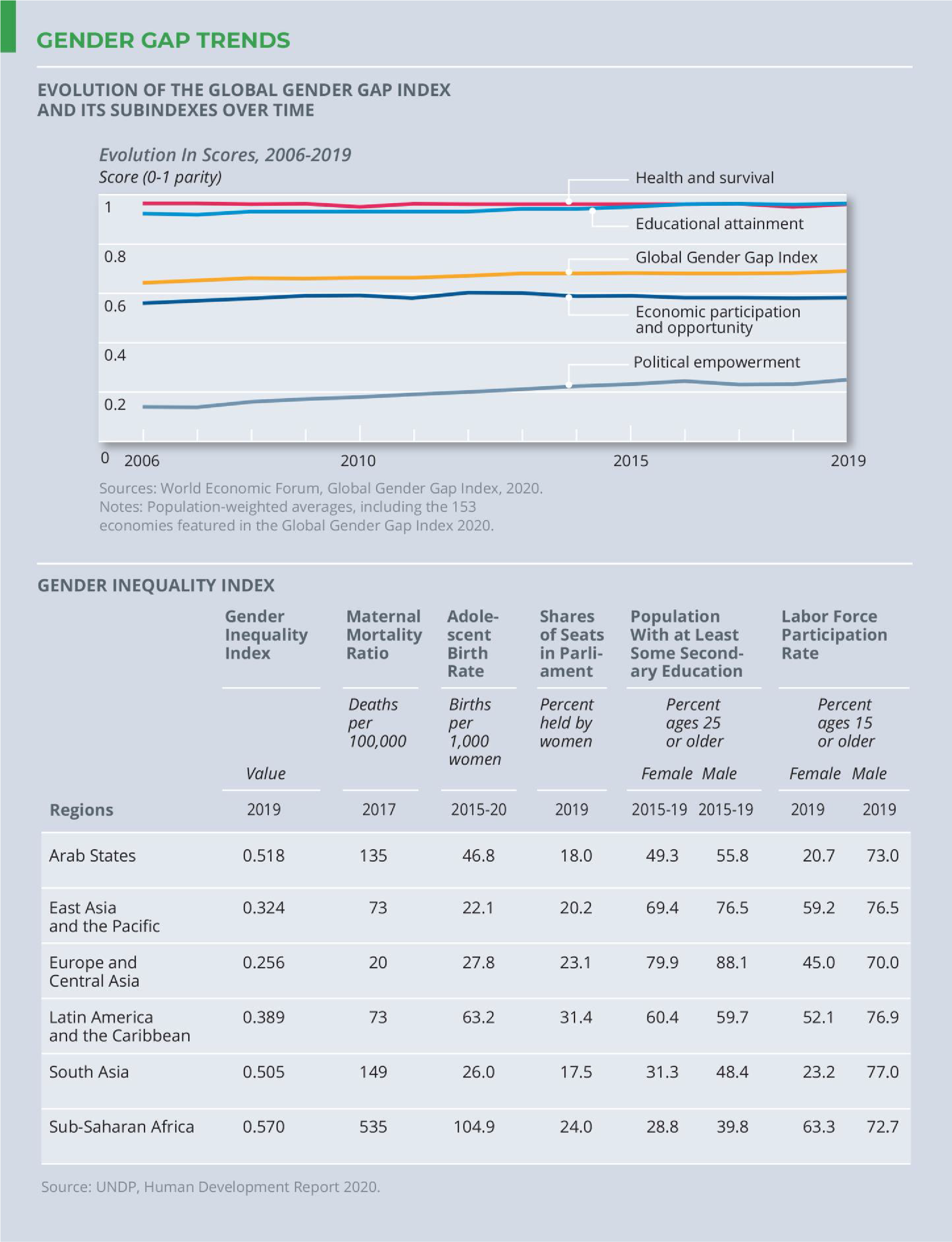
After decades of improvements in women’s formal education, economic participation, and political leadership, progress in many countries has slowed in recent years, due to the slowing progress in some regions against higher-level human development goals, strongly held views of women’s roles in a number of countries, and the economic effects of the COVID-19 pandemic. Moreover, deep-seated patriarchal attitudes are likely to remain a hindrance to gender equality in some regions during the next two decades. Some polling and research indicates that these attitudes may change over generational periods, with the potential for more rapid change due to societal disruption, such as wars and perhaps the pandemic. Expanding Internet access and e-commerce platforms over time could also enable more women in more places to push for greater equality, as well as improve their prospects for employment and higher levels of education, but also might facilitate repression by authoritarian regimes.

DECADES OF PROGRESS…


For many decades, the world has seen large increases in gender equality, and in most countries, the legal barriers to women’s educational, economic, social, and political participation are gone. Worldwide, women are more educated today than at any point in history, and gender gaps between women’s and men’s academic attainments are rare in countries with high levels of educational achievement. In fact, women in some 50 countries on average have achieved a higher level of education than men have, and in others, they live longer and are healthier.

Female labor force participation rose markedly in the 20th century, and in a majority of countries at all income levels women’s participation in paid labor is higher today than it was in 1990. Since the end of World War II, 64 countries on every continent have had at least one elected or appointed female head of state. Eighty-five percent of them took office after 1990. Latin America and the Caribbean are notable with 12 of the region’s 33 countries having had female heads of state (including presidents and prime ministers), with women currently leading Aruba, Barbados, St. Maarten, and Trinidad and Tobago.

Growing Say in Foreign Policy. An increasing number of countries are incorporating advancement of gender equality into their foreign policy establishment and agendas. As of March, 32 countries had female foreign ministers, 25 had female ministers of defense, and several had ambassador-level positions with the explicit aim of promoting women’s rights. Sweden and Mexico have instituted explicitly “feminist” foreign policies—which prioritize devoting resources to improving women’s rights as well as ensuring representation in foreign and security institutions—with possibly more countries following suit in the near future.

Exercising Greater Choice. As women have gained opportunities, they are seeking roles in society beyond those traditionally afforded them. In Japan, women are consciously postponing or foregoing marriage, partly reflecting their dissatisfaction with enduring societal expectations that women will continue to perform the bulk of unpaid domestic chores even when they work outside the home. Moreover, labor force participation rates for women in Japan have increased during the past several decades. Similarly, Brazilian women have significantly increased their participation in the workforce since 1990, and they are prioritizing careers and other forms of personal goals over large families,
in part because of higher rates of education for women and greater urbanization.

Increasing Public Advocacy. Women have also used their greater political voice to shed new light on harassment, discrimination, and violence through social movements, such as #MeToo, India’s #IWillGoOut for the unhindered right to go out in public, and Latin America’s #NiUnaMenos, spotlighting violence against women, and through myriad marches, protests, and on-line campaigns. In early 2020, millions of Mexican women went on a national strike to protest gender violence—a move enabled by sympathetic employers and universities.

International Recognition of Women’s Issues. During the past 25 years, countries have come together at the UN to pass several landmark agreements that protect and empower women, including the Beijing Platform for Action in 1995 with the goal of achieving legal gender equality, UN Security Council resolution 1325 on “Women and Peace and Security” affirming women’s vital role in resolving conflicts and maintaining peace, and the UN Millennium Development Goals in 2000, which included “gender equality and empowerment of women and girls” as one of its tenets.

Agricultural Practices. Global water demand for agriculture—the single largest consumer of water—is projected to increase by 19 percent from current levels by 2050. By 2040, about 40 percent of all irrigated agriculture is expected to face extremely high water stress.


(Graphic 1: GENDER GAP TRENDS - Click image to enlarge)

…SLOWING IN SOME AREAS


Despite these initiatives and advances, progress toward gender equality is slowing in some areas. To some extent, this reflects the slowing gains in overall human development; for example, basic levels of education have largely been met but expanding access to secondary education is a more difficult challenge. The COVID-19 pandemic has illustrated how quickly progress can be reversed for women, particularly because women have been more likely to stay at home to care for children. Although women are the primary producers of food in many countries, they have limited or no rights to land ownership in some parts of the world. Even where laws allow women to own land, such as in Kenya, no titles have been passed to women.

Physical Abuse Levels Remain High. Across all societies, women continue to face physical risk and dangers at home and work. Sexual violence—including at the hands of family members or domestic partners—remains a global scourge. A WHO study in 2020 estimates that more than one in four women have experienced physical or sexual violence form an intimate partner in their lifetime. The UN estimated in 2018 that globally, 137 women per day are killed by a partner or family member. Russia and Hungary, for example, have reduced protections for women, including decriminalizing domestic and sexual violence. Multiple studies also show that violence against women reduces economic productivity, reducing global output by as much as 4 percent, by one estimate. A number of recent studies indicate that globalization and expanding access to the Internet and social media have increased the sexual exploitation of girls and women.

Continued Discrimination in the Workplace. World Economic Forum data indicate that the global gender gap in both paid labor participation and wage equality has actually widened since 2017. A survey completed between 2013-2018 of 2,300 publically listed companies in 14 well-established industries across a range of sectors, including energy, materials, industrials, consumer products, utilities, and waste services, indicated that women hold only 13 percent of board seats. Globally, women are more women are more likely than men are to work in the precarious and ill-paid informal sector, far less likely to start their own businesses, and are underrepresented in STEM fields. One study in 2019 indicates that by 2030, an estimated 40-160 million women may need to transition into higher skilled roles; by comparison, 60-275 million men may need to transition.

Hurdles to Political Participation. Even with a dramatic rise in female legislators since the 1990s, the proportion worldwide is only about 25 percent. In some countries, women who seek or attain political office have to deal with threatened or actual violence, including murder, often deterring other women from striving for public office. Subordination of women to men regardless of educational level is enshrined in family law in many parts of Sub-Saharan Africa, the Middle East, and South Asia.

THE LONG ROAD AHEAD


Deep-seated patriarchal attitudes worldwide, as well as some economic and demographic trends, are likely to remain a hindrance to gender equality during the next two decades. Although a Pew survey from 2018 indicates that attitudes are shifting—in a majority of countries surveyed, younger people are more likely to favor gender egalitarianism—which suggests that these attitudes may change over generational periods, about 50 percent of respondents to a UNDP survey in 2020 claimed that men make better political leaders and business executives.

Similarly, a Pew survey in 2020 across 34 countries representing views from each global region on gender equality reported that 40 percent of respondents stated that men should have preferential treatment when jobs are scarce, despite the vast majority of respondents stating it was important for women in their countries to have the same rights as men.

IMPACT OF COVID-19 PANDEMIC ON WOMEN'S INCOMES, EDUCATION, AND HEALTH

The global economic disruptions caused by the COVID-19 pandemic had a greater effect on women because they tend to work in economic sectors hit hard by the pandemic, such as the hospitality industry and other service work. According to a poll conducted in late-2020 in 13 Latin American and Caribbean countries, female workers in the region were 44 percent more likely than men to lose their jobs at the onset of the pandemic. In 2020, women in Europe experienced a total wage bill loss of about 8.1 percent compared with just 5.4 percent for men. In addition, stay-at-home measures designed to stem the spread of COVID-19 combined with social expectations have frequently compelled women to give up paid work or put their educations on hold to care for their families and have put them at greater risk of domestic violence.

The Organization for Economic Cooperation and Development, the World Bank, and the IMF project a robust global growth rate this year, albeit acknowledging considerable uncertainty regarding the global trajectory of the COVID-19 pandemic during the next few years, but there are likely to be large regional variations that will affect women's ability to reenter the workforce in some countries. Developed economies probably are going to recover faster, while emerging markets and developing countries are unlikely to rebound to pre-COVID-19 GDP growth levels until after 2022, according to these projections. Studies of pre-COVID-19 recessions suggest that women have more difficulty than men regaining employment and recouping lost wages during a recovery.

The diversion of medical resources to deal with the outbreak probably has diminished women's access to health and reproductive services. In India, for example, medical services for women had to be re purposed to support COVID-19 efforts.


Role of Societal Structures and Traditions.
Patriarchal family structures that remain the norm in several parts of the world often perpetuate gender inequality. Child brides—particularly prevalent in parts of Sub-Saharan Africa and South Asia—are particularly powerless, cut off at an early age from educational and economic opportunities, and at high risk for both domestic violence and maternal injury and death. Many societies’ acceptance or rejection of gender equality could hinge on whether they see it as an alien or Western value. Any values discussion may be further complicated by continued large migration flows across national borders, which will bring groups with widely varying views on gender equality into close proximity.

The ultimate in devaluation of women and girls in a society—denial of their right to live—is manifested by “femicide,” “dowry deaths,” “honor killings,” and other assorted murders of females worldwide. The number of nations with skewed sex ratios as the result of the abortion of female fetuses and killings of newborn baby girls quadrupled between 1990 and 2016. Sex-selected abortion is most prevalent in China and India, although it is also common in the South Caucasus, Southeast Europe, and other countries with a preference for sons.

Impact of Economic and Demographic Trends. Pandemic-related economic problems will place fiscal constraints on many countries that will reduce public outlays for health, education, and infrastructure that women in many countries rely on. Developed countries may also react to the pandemic’s disruption to supply chains by on-shoring or automating manufacturing, adding to strains on developing countries where women’s rights face the greatest challenges. The growing burden of caring for increasingly aging populations, especially in Europe and East Asia, is also likely to fall disproportionately on women who provide most of the care in many societies.

WHAT COULD CREATE A DIFFERENT TRAJECTORY?


The Promise of Technology.
Technological advances during the next two decades could provide opportunities for more women to improve their prospects for employment, attain higher levels of education, and advocate for their rights, if accompanied by a supportive societal and cultural environment. Social media platforms have been essential for connecting women with common concerns, promoting movements such as #MeToo and India’s #IWillGoOut movement, and organizing massive demonstrations. As Internet access expands globally, more women and girls could have better educational opportunities and access to information. In addition, a growing number of e-commerce sites are providing a means for women entrepreneurs to gain access to financing and global markets. The UN, for example, is sponsoring an e-Trade for Women initiative that seeks to develop women digital entrepreneurs in developing countries.

A Pandemic Silver Lining? The COVID-19 pandemic may have the potential to catalyze societal shifts in attitudes toward gender equality during the next two decades. Some equality breakthroughs in the 20th century were catalyzed by global and regional cataclysms that reordered societies. For example, many Western women gained the vote as the result of the geopolitical and societal upheavals of World War I, and women entered the workforce in large numbers during World War II. Historians have also cited Rwandan women’s progress following the 1994 genocide, which forced dramatic shifts in women’s roles in that country, including gender parity in its legislature and the right of women to own land and work in paid employment.

In the COVID-19 era, it became apparent that a large number of jobs viewed as “essential”—from medical professionals to grocery store employees—are performed by women in frequently perilous conditions. As a result, women—including those in traditionally low-status care work—could gain a new platform for demanding a greater voice, respect, and financial reward.

GENDER EQUALITY IMPLICATIONS FOR ECONOMICS, GOVERNANCE, AND CONFLICT

Gender equality has global strategic implications with a body of scholarship demonstrating that treatment of women in a society is a leading indicator of that society's ability to develop, democratize, and exist peacefully with its neighbors. This is an area of ongoing research and debate. The most empirical evidence is in the area of economics.

  • Economic Prosperity: There are long-recognized links between increases in female autonomy (e.g. freedom to delay marriage and to work outside the home) and economic prosperity going back centuries. The economic growth of China and South Korea was preceded by a rise in female autonomy in the 1960s and 1970s, whereas gender inequality has been associated with lower GDP growth in other developing countries during the last few decades. Prosperity in more equal societies is due in part to women's investing more of their earnings in their families and communities than men typically invest. In addition, international financial institutions and investors have found an inverse correlation between return on investment and high levels of gender-based violence and discrimination in a society.

  • Democratic Governance: A body of scholarship indicates that patriarchal families that allow women little say over the number of children they produce consistently undermine the ability of a society to form lasting democracies. For example, patriarchal values such as conformity, deference to hierarchy, self-censorship, and suspicion of outsiders are much more amenable to authoritarian forms of governance. In addition, societies with high population growth- and by extension more youthful populations- are statistically more prone to failed democratization attempts than societies with a higher median age.

  • Instability and Conflict: Societies where violence against women is entrenched are more prone to instability and conflict. Habitual violence in the home conditions those who witness it, such as children, to see violence as the means for dealing with differences, whether ethnic, religious, cultural, racial, or ideological.
DEEPER LOOKS

The Future of Public Activism:
Populations Poised To Increase Pressure Worldwide PDF Version - Download

This paper was produced by the National Intelligence Council’s Strategic Futures Group in consultation with outside experts and Intelligence Community analysts to help inform the integrated Global Trends product, which published in March 2021. However, the analysis does not reflect official US Government policy, the breadth of intelligence sources, or the full range of perspectives within the US Intelligence Community.

Over the next two decades, populations in every region and in every type of political system are likely to demand more from their political and corporate leaders, potentially prompting those leaders to be more responsive and possibly accountable but also risking societal divisions, broader repression, and less coherent policies. During the past decade, public activism—direct public action intended to impart social or political change—has been on the rise in every region, including high-profile protests and demonstrations. The combined increases in prosperity, education, urbanization, and access to communication technologies are equipping people to express their interests and needs and seek more government action. As public activism continues to expand and potentially becomes more sophisticated, governments of all types will seek avenues to respond—either by attempting to appease public demands or by actively suppressing avenues for activism. Over time, this dynamic will offer the prospect for more accountable leadership and improved democratic health, but in the near term, it could increase factionalism and reduce policy coherence and effective strategic planning.


MASS PUBLIC MORE SKEPTICAL OF INSTITUTIONS—ESPECIALLY GOVERNMENT


Worldwide trust and confidence in public and private institutions and their leaders have been persistently low during the past decade, especially among nonelites. Various polls consistently indicate that approximately half the nonelite public distrusts institutions, including government, business, media, and nongovernmental organizations. Elites are defined as people who are college educated, in the top 25 percent of household income in each market, and exhibit significant media consumption. According to one study of 16 high-income countries over several years, the nonelite respondents claiming trust in government during the period 2012-2020 never exceeded 45 percent. In an online survey of 28 geographically diverse medium- and high-income countries, the 2017 Edelman Trust Barometer found that more than half the people surveyed said the “system” was failing them, and only 15 percent indicated it was working for them.

  • Dissatisfaction With Democracy. A 2019 Pew Research Center survey conducted in 34 democratic countries found that a median of 52 percent of respondents were dissatisfied with the way democracy was working, and only 44 percent were satisfied. Sixty-four percent of respondents disagreed that elected officials care what people like them think, compared with just 32 percent who agreed. In most countries polled, those who did not believe elected officials care about the opinions of ordinary people were also unhappy with how democracy was performing in their countries.

  • Trust Gap Widening Between Elites and Mass Public. Compared with elites, who tend to have more favorable views of government and markets, the mass public is much more skeptical that government and other institutions are performing effectively. The 2020 Edelman Trust Barometer conducted in the United States, Western Europe, Brazil, China, Japan, and South Korea, found that just 52 percent of the mass public surveyed trusted business and only 45 percent trusted government, compared with 69 percent and 55 percent of elites, respectively. A series of polls by Edelman from 2012 to 2021 revealed that the gap in trust between the elite and everyone else had more than tripled with respect to key institutions, including nongovernmental organizations, business, government, and the media.


Publics in every region have become more concerned about the future and less optimistic, even as their personal incomes have risen. People’s average standard of living around the world has steadily improved during the past half century, with global per capita GDP growing in constant dollars from $3,700 in 1960 to nearly $11,000
in 2018.

  • In some countries, the share of the population expecting their children’s future financial situation to be worse than that of their parents has risen sharply—rising 35 percent in Brazil and 25 percent in Tunisia between 2013 and 2018, for example. Even before the COVID-19 pandemic, the Pew Research Center found in 2018 that a median of just 34 percent of respondents in 18 countries with advanced economies expected the children of that country to be better off than their parents when they become adults. Among nine emerging economies, the figure was 42 percent.

  • The 2020 Edelman Trust Barometer found that only small percentages of people in several advanced economies thought they would be better off in five years, including Japan (15 percent), France (19 percent), Germany (23 percent), and the United Kingdom
    (27 percent).


This distrust in the system and worries for the future reflect growing public concern about corruption, globalization, eroding social values, immigration, and the pace of innovation, according to Edelman Trust Management’s analysis of its survey results during the past 20 years.

Public opinion data indicates that majorities across Sub-Saharan Africa (55 percent), the Middle East and North Africa (65 percent), and Latin America (53 percent) believe that corruption is increasing in their region. According to a 2019 report by Transparency International, two-thirds of countries scored below average in the level of perceived corruption. Countries with the highest levels of public concern about corruption also have the highest levels of political power concentrated among the wealthy elite. Globally, according to a number of international governance experts, perceptions of corruption are now one of the most dominant factors driving political change.


(Graphic 1: PERCEPTIONS OF CORRUPTION DRIVING PUBLIC OUTCRY- Click image to enlarge)


PUBLIC ACTIVISM ON THE RISE THROUGH MULTIPLE CHANNELS


This discontent has led to a surge in public activism in the past decade, in every region and across all types of governments, with varying degrees of impact. As one scholar has noted, “There is not a political model that seems to be doing well or that is inoculated from the kind of uprisings the world is witnessing.” The head of Asia research at risk analysis and strategic forecasting firm Varisk Maplecroft predicted in January 2020, before the widespread impact of COVID-19, that 80 percent of the 125 countries the firm analyzes would experience an upsurge in unrest in the next two years. People have used some very visible tactics, including mass protests and nationwide boycotts, as well as lower profile methods, such as advocacy campaigns, social media operations, and the mobilization of key influencers, to try to exert pressure on their governments, institutions, and the business sector.

SUBNATIONAL RESPONSES TO PUBLIC PRESSURE

Exclusive forces on national-level dynamics underrepresents the impact that the public sometimes is able to have by changing the decision calculus of lower-level political leaders. Subnational elected leaders are more sensitive to strong swings in public sentiment than national-level leaders, given their familiarity with their constituencies.

According to one recent study, subnational policies often shift to reflect public views over time, especially through the gradual calibration of policymakers' decisions to voters' intent, and this influence has increased over the past 8 decades.


Mass Protests

In 2019, there was a spike in protests worldwide targeting national-level political leadership, but this rise in public demonstrations is part of a decade-long trend. A study by the Center for Strategic and International Studies found that mass protests increased annually by an average of 11.5 percent between 2009 and 2019, with the rate of growth highest in Sub-Saharan Africa. In 2019 alone, antigovernment protests took place in 114 countries and territories, and some of these protests—including marches and large-scale public demonstrations as well as sporadic violence—resulted in notable change, including the removal of political leaders (Algeria, Bolivia, Iraq, and Sudan) or policy adjustments (Chile and Hong Kong). In 2019 in Hong Kong, months of large street protests initially resulted in the withdrawal of legislation that restricted some freedoms for Hong Kong citizens, but in response, Beijing imposed a new national security law in 2020, that targets activities perceived as fostering political independence. In Chile, government leaders adopted changes in response to protesters’ demands, and in Ecuador elected leaders granted concessions to protesters participating in mass demonstrations. In contrast, increasing protests across Russia in support of opposition leader Aleksey Navalnyy have been met with arrests and an extended sentence for Navalnyy.


Boycotts, Civil Disobedience, and Other Public Pressure Campaigns

Civil resistance activities—unarmed civilians’ use of nonviolent tactics to withhold consent—have grown steadily during the past five decades, putting pressure on government leaders and corporations alike.

  • Targeting Governments. The 2019-20 transportation strike in France—the longest in the country’s history—principally over President Emmanuel Macron’s effort to overhaul the country’s pension system led to the government’s reversal of planned changes to national pension policy.

  • Targeting Corporations. Both consumers and employees are pressing private corporations and organizations to adjust behaviors and policies to align more closely with their interests, needs, and values. Employees are increasingly engaging in walkouts and boycotts when their companies do not conform to values that they deem important, according to Edelman Trust Management, which has studied trust levels during the past 20 years. In response to growing requests from customers, international corporations, including energy companies and investment firms, are building environmental sustainability into their production and investment decisions. Consumer demands often effect change much faster than government regulations.


Social Media Engagement


During the past two decades, social media engagement and online campaigns have become an increasingly critical component of public activism, spreading information quickly and allowing groups to organize virtually without alerting authorities. At the same time, individuals, groups, and governments have manipulated online content to spread disinformation, undermine groups and causes, and at times, provoke public action and conflict.

  • Connection and Communication. During the 2011 Arab Awakening, large numbers of people harnessed social media networks to organize participation within countries and generate attention globally. Social media played a significant role in communicating developments to influential people outside and across the region, and increasing the visibility and potency of the movement.

  • Disinformation. According to a report by Oxford University, disinformation campaigns occurred in 70 countries in 2019, up 250 percent in two years. Disinformation is an efficient tool for individuals and organizations; true stories take about six times longer than false stories to reach 1,500 people, according to a recent study by the Massachusetts Institute of Technology. False news stories are about 70 percent more likely to be retweeted than true stories.

  • Divisive Rhetoric. Governments and affiliated organizations increasingly are using social media to try to shape popular opinion and influence public behavior at home and abroad. The pro-Kremlin Internet Research Agency, for example, conducts operations online, including spreading falsehoods about the coronavirus, to induce distrust in democratic institutions and undermine the European Union. The Independent International Fact-Finding Mission on Myanmar found that some Burmese authorities disseminated hate speech toward the Rohingya population through Facebook and other media platforms in 2017, creating a climate in which extremist views gained traction.


Lower Profile Efforts


In addition to the highly visible protests, pressure campaigns, and social media engagement, groups and individuals have employed behind-the-scenes tools to push for political outcomes, including working with issue-based advocacy organizations or through key policy influencers. Efforts to shape policy outcomes through persuasion of government officials from countries at every stage of development constitute an increasingly lucrative business.

  • Advocacy. Often led by nongovernmental organizations, advocacy efforts depend heavily on public support and have influenced government policies on issues ranging from arms sales and nuclear nonproliferation to single-country policies and development assistance. Strong public backing can be instrumental in the likelihood of an advocacy campaign’s success. One recent study of advocacy success in a sample of European markets found that
    the effectiveness of advocacy operations in achieving intended policy outcomes increases proportionately with the strength of public support for that objective. Another study of the relationship between lobbying efforts and government responsiveness across 13 policy areas in Germany found that principle-based “cause groups,” strongly backed by public opinion, increased government responsiveness through the provision of campaign contributions, electoral support, and information to governments.

  • Key Influencers. Outside the governing structure, influencers, such as business elites, leaders of issue-based nonprofit organizations, and prominent social media personalities, also affect policy by facilitating connections between the public and government leaders. By channeling their sentiments through these influencers, groups and private individuals can maximize the chances of substantive policy change.

CHANGING SOCIETAL CONDITIONS PORTEND GREATER PUBLIC ACTION


Changing economic and social conditions are providing populations in every region the resources, time, and tools to channel their needs and interests into action and to engage officials and other elites with greater intensity, frequency, and effectiveness. Populations in the most developed countries are already well positioned to do this, and populations in developing countries are likely to become increasingly equipped to express their interests and needs as material conditions improve.


Increasing Prosperity


Greater prosperity, especially in developing countries, is likely to increase the intensity of future public activism, as people have greater free time, higher expectations, and better access to the tools for participation. The reduction in people’s preoccupation with immediate financial concerns facilitates a wider scope of awareness and ambition beyond immediate needs. Moreover, as people become wealthier in developing countries, they often express rising economic and social expectations in terms of material benefits, such as better healthcare, housing, or education, which governments are often not in a position to provide expeditiously.

  • From 1990 to 2017, the percentage of people living on less than $1.90 per day dropped from 36 to 9.2 percent of the world’s population. These gains were not evenly distributed across all regions; the biggest change occurred in East Asia and the Pacific, whereas the change in Sub-Saharan Africa was smaller. If economic growth patterns were to match historical trends, poverty would fall to about 5 percent by 2030, but disparities are likely to grow. The global pandemic is likely to make poverty reduction more difficult to attain in the next 3 to 5 years, and under most projections, Sub-Saharan Africa is still likely to contain a quarter of the world’s population in extreme poverty in 2030.

  • In 2018, for the first time in history, more than 50 percent of the world’s population reached the middle class, and by 2030, estimates suggest that the middle class could exceed 63 percent. The vast majority of the increase in the middle-class population has come from Asia in the past decade, principally China and India, but Sub-Saharan Africa is poised to make additional gains. Consumer spending in the region, which is driven primarily by the middle class, was an estimated $1.3 trillion in 2010 and is likely to double by 2030, according to the Africa Development Bank Group (AfDB). The AfDB forecasts that the share of Sub-Saharan Africans qualifying as middle class will grow from today’s 13 percent to 42 percent by 2060.

  • As a result of these factors, publics in most Sub-Saharan Africa and East Asia countries are likely to be more engaged in the next decade. China’s middle class has grown rapidly from 3.1 percent of the population in 2000 to 50.8 percent in 2018. As a result, nearly 670 million people have greater resources to make demands on their government.
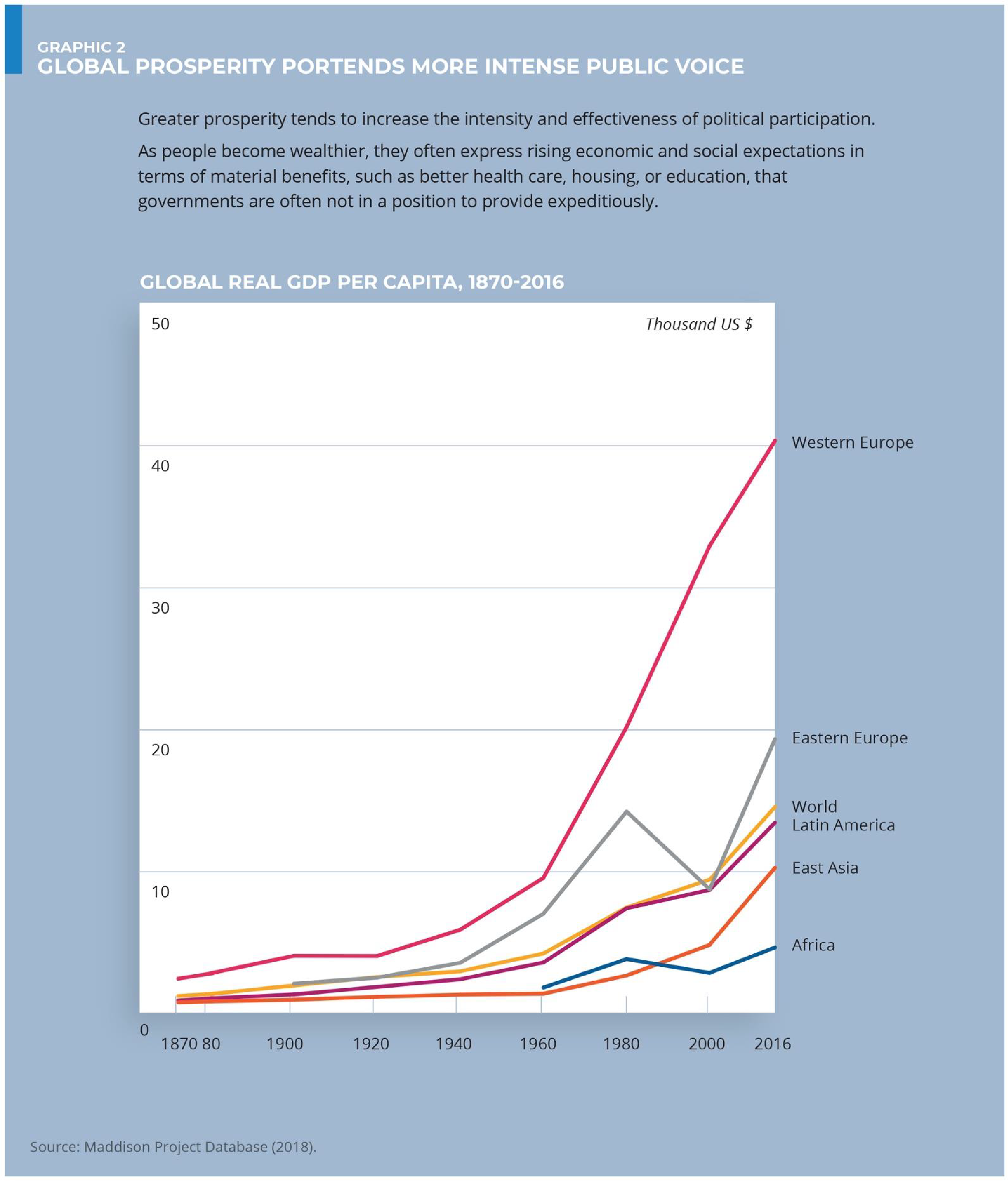

(Graphic 2: GLOBAL PROSPERITY PORTENDS MORE INTENSE PUBLIC VOICE - Click image to enlarge)


Rising Education Levels

In all regions and for both genders, increasing access to education is providing people greater awareness of the domestic and international dynamics shaping their lives as well as an increasing understanding of the levers for change at their disposal. During the past two centuries, the total population of people over age 15 with some formal education has quadrupled, from 20 percent in 1820 to 80 percent today, and by 2050, the proportion of people receiving no formal education is likely to drop to almost zero. East Asia, Europe, and North America have already attained high levels of education and are expected to maintain those levels in coming years whereas less-developed regions are poised to experience continued growth.

  • From 2020 to 2040, the percentage of the population projected to complete secondary-level education in Sub-Saharan Africa will increase from 44 percent to 57 percent, according to UN Educational, Scientific, and Cultural Organization data, and from 66 percent to 79 percent in South Asia. Overall, the least developed countries are projected to experience an increase from 43 percent to 56 percent.


Expanding Communication Technology Capabilities

Social media and the inexpensive, near-instantaneous flow of information have grown exponentially, giving real-time awareness of events and the tools and techniques to improve people’s ability to organize. Social media also has created information silos and facilitated the spread of disinformation, which has further undermined trust and heightened social tensions. Within countries, governments have tried to harness new technologies to restrict movement and free expression, but technology also provides visibility into government policies and the provision of services, and globally, increased access to the Internet offers knowledge of transnational dynamics and awareness of similar efforts in other countries. This greater global connectivity is likely to magnify collective action, extending the trend of increasing public confrontation with traditional hierarchies and devaluation of conventional sources of authority, including widely trusted authorities that had served as sources of societal cohesion. Social media and other digital communication tools give organizers the ability to generate and focus public attention on particular issues and causes. Individuals can bypass the publishing industry and other traditional intermediaries and communicate directly to the broader public to achieve a range of results, from informing and catalyzing action to misleading and manipulating.

  • In just the past five years, the number of people using the Internet has grown by 36 percent, an equivalent of 1.24 billion new users. Global social media users increased to 4.2 billion in 2021, an 82 percent gain in five years and equivalent to 53 percent of the world’s population.

  • Projecting forward, global mobile Internet penetration is forecast to reach 61 percent of all populations by 2025 and 90 percent by 2030, up from 49 percent in 2019. Penetration in Sub-Saharan Africa is likely to climb from nearly 26 percent in 2019 to 39 percent by 2025. One estimate suggests that subscriptions to mobile broadband in Sub-Saharan Africa will increase by an additional 167 million subscribers by 2025, and the number of mobile Internet users will grow from 239 million in 2018 to 483 million in 2025. Comparatively, industry forecasters expect a 5.5 percent increase in mobile Internet users through 2025 in the Asia-Pacific region, a 4 percent increase in Latin America, and a 0.5 percent increase in Europe. These projected differences reflect Africa’s comparatively low saturation rates and large youth population.
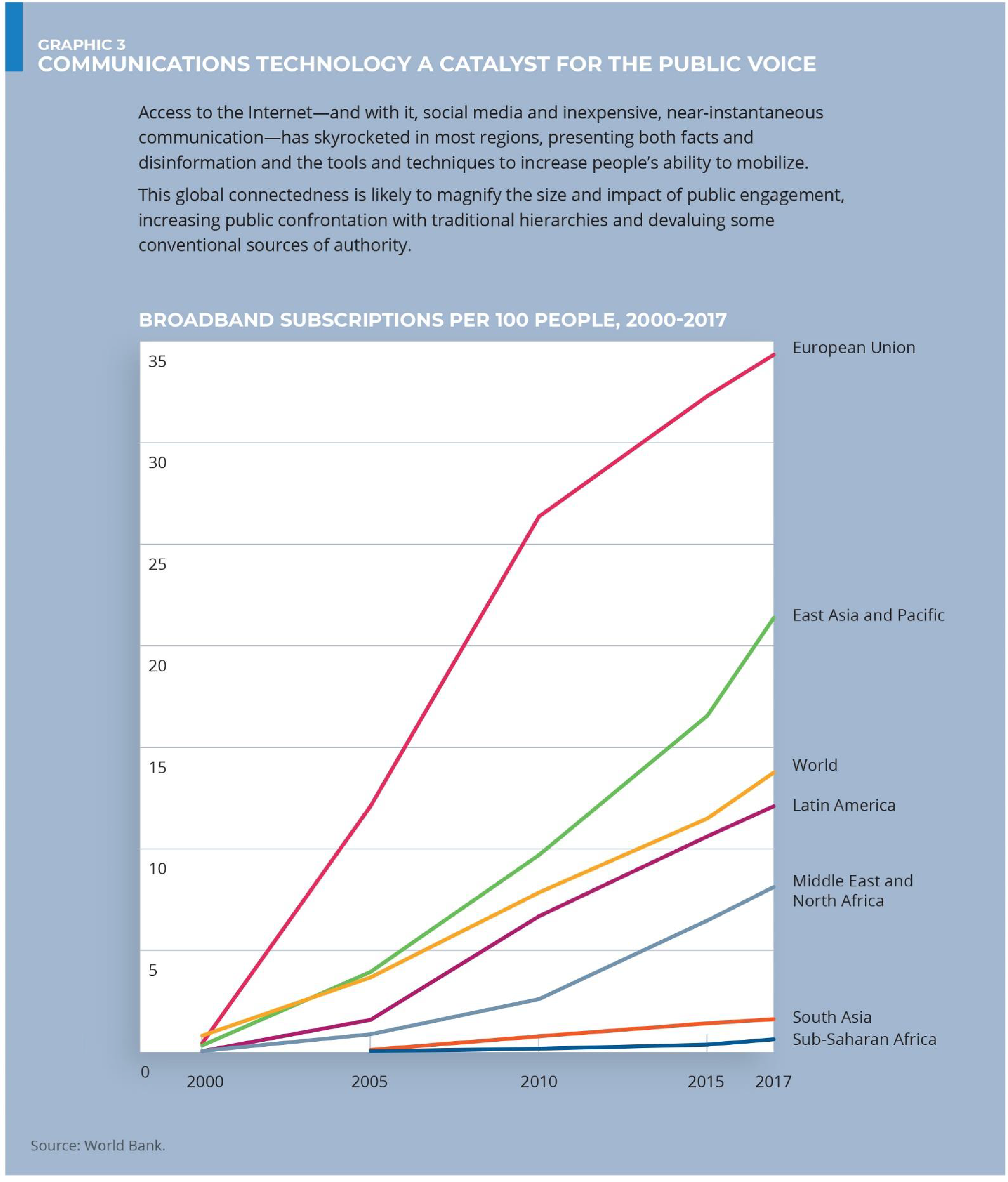

(Graphic 3: COMMUNICATIONS TECHNOLOGY A CATALYST FOR PUBLIC VOICE - Click image to enlarge)


Intensifying Urbanization

Urbanization is transforming communities globally, fostering more shared experiences while facilitating greater collaboration. According to 2018 UN data, the percentage of people living in urban areas is likely to surge from 56 percent in 2020 to 65 percent by 2040, totaling an estimated 5.94 billion people. The number of megacities—with populations exceeding 10 million people—is projected to climb from 33 million in 2018 to 43 million in 2030. In Nigeria, for example, Lagos had a population of 7.3 million in 2000 and is expected to have 24.4 million by 2035. Given these trends in urbanization, the scale of the challenges endemic to cities, and the history of public movements originating in high-density population areas, the number of people agitating for policy change is likely to increase.


GOVERNMENT RESPONSES NOT ADDRESSING UNDERLYING GRIEVANCES


As public activism expands, governments will be compelled to respond to maintain stability—either by accommodating public demands or by taking harsher, repressive actions—but may be unsuccessful because tactical measures often do not address the underlying grievances.


Accommodation

During the past decade, many government responses to greater public activism have sought to remove the proximate trigger for public demands. This response has often been the removal of a new law or tax or the ouster of an unpopular leader. These measures have satisfied publics temporarily but rarely addressed broader, systemic concerns, as evidenced by the persistence in high levels of public action.

  • After protests began in 2018, the Government of Haiti reversed its fuel tax increase, and in 2019, the Government of Lebanon recalled its planned tax on WhatsApp calls. Neither country has made meaningful strides toward addressing economic inequality and corruption, however, which are the core underlying grievances.


Repressive Measures

Many governments have responded to protests by trying to suppress public activism, including by jailing leaders, deploying security services, and shutting down the Internet.

  • In October 2019, Chile’s military and police crackdown on protesters left dozens dead and thousands injured. Iraqi security forces killed approximately 700 protesters—organizing in opposition to perceived corruption, unemployment, and a lack of public services—between October 2019 and February 2021. Local, state, and national officials in India have reacted to protesters by cutting off access to the Internet more than any country in the world—more than 400 instances in the past four years.

  • Even repressive regimes appear to be limited by evolving social norms, and violent reprisals have been the exception rather than standard practice. Despite the threat that prodemocracy movements in Hong Kong pose to the Chinese regime’s efforts to project political uniformity, China’s officials have shown some restraint in their treatment of protesters. Changing global norms could increasingly constrain government responses to widespread discontent or persuade governments to change tactics to less overt forms
    of repression.

GREATER RESPONSIVENESS BUT DIMINISHING POLICY COHERENCE, INCREASING FACTIONALISM


Increasing public activism can be an indication of democratic health for the future and offer the prospect of more accountable leadership, but this dynamic also comes with risks, including more factionalized government, reduced policy coherence, and lack of long-term strategic planning. When public demand is consistent and overwhelming, it can restrict the range of available policy options. In other cases where public opinion is more differentiated, policy elites may struggle to manage competing demands, and decisionmaking may become paralyzed.


Increased Responsiveness


Public engagement with political leadership can improve responsiveness to public needs and increase general accountability. For example, heightened public pressure in Chile in 2020, starting with protests over subway fare hikes, generated some tangible results, ranging from increases in the monthly allocation of retirement pensions to promises to revise the old constitution, which was drafted during Chile’s military dictatorship. The 2019-20 transportation strike in France over rising fuel prices resulted in President Macron’s commitment to overhaul the country’s pension system. Although this dynamic is a longstanding feature of French politics—public protests followed by government concessions—it depicts a pattern of the public demanding government responsiveness that is being replicated in other places.

Reduced Policy Coherence

Increasing public agitation on competing sides can further polarize political processes and undermine elected officials’ efforts to reconcile divergent policy views and reach compromise solutions to national challenges. This can result in fluctuating, contradictory, and ineffective policies.

  • During the past decade in Argentina, public protests and obstructionist opposition parties have further polarized politics and limited the ability of successive governments to address longstanding challenges such as widespread poverty and a growing national debt. Policies have oscillated between fiscal austerity to reduce the debt levels and generous social expenditures—exacerbating the fiscal challenges.

  • Occasionally incoming leaders respond to niche pressures or depart from orthodox policies that are the result of longstanding commitments and negotiated tradeoffs. Indian Prime Minister Narendra Modi came to office in 2014 as a trade liberalizer under the slogan “Minimum government, maximum governance.” However, in response to political pressures and to protect certain domestic industries, including the agricultural sector, he raised import duties on more than 40 goods in the 2018-19 budget and levied export taxes on more than 400 textile items in just two months in 2018. Policies designed to satisfy narrow constituencies risk sacrificing long-accepted strategic logic and jettisoning carefully crafted international agreements.