





"The center provides a unique environment to optimize the U.S. government's collective knowledge and formidable capabilities to identify and counter the terrorist threat to the nation."
NCTC comprises employees from partner organizations that include: Central Intelligence Agency; Department of Justice/Federal Bureau of Investigation; Departments of State, Defense, and Homeland Security; and other entities that provide unique expertise such as the Departments of Energy, Treasury, Agriculture, Transportation, and Health and Human Services; Nuclear Regulatory Commission; and the U.S. Capitol Police.
The NCTC also maintains productive relationships with foreign partners. It is the diversity of backgrounds and disciplines fused together in an integrated environment that enriches the NCTC analysis, provides alternative perspectives, and breaks down cultural and physical barriers.
Bomb Threat Stand-Off Distance Chart
Threat descriptions, explosive capacities, building evacuation distances, and outdoor evacuation distances.
Intelligence Guide For First Responders
This Interagency Threat Assessment and Coordination Group (ITACG) Intelligence Guide for First Responders is designed to assist state, local, tribal law enforcement, firefighting, homeland security, and appropriate private sector personnel in accessing and understanding Federal counterterrorism, homeland security, and weapons of mass destruction intelligence reporting.
Daily Threat Reporting
A daily accounting of threat reporting and actions taken.
bulletAnalytic Assessments
Daily analytic products for senior USG officials and the broader CT Community on the full range of terrorist topics. Analysis also provides alternative views on terrorism issues.
Situational Awareness Reports
Situational awareness reports of terrorist threats, incidents, and reported plots worldwide.
Alerts, Advisories, and Warnings
Topics of interest that are widely disseminated to domestic and overseas operators and analysts.
Strategic Operational Plans
Integrated and synchronized across U.S. government agencies, describing specific objectives, department / agency roles and responsibilities, tasks, and activities for counterterrorism.
NITTF Assessments
Executive Order (E.O.) 13587 and the National Insider Threat Policy directs the NITTF to conduct ‘’independent assessments of the adequacy of agency programs to implement established policies and minimum standards’’ and to report the results to the Steering Committee. It directs U.S. executive branch departments and agencies (D/As) to ‘‘provide information and access…to enable independent assessments.’’ The National Insider Threat Policy also requires the NITTF to conduct assessments to determine the level of organizational compliance with the Policy and Minimum Standards. All executive branch D/As that possess national security information or own or operate a classified network are subject to independent assessments.
An independent assessment is an integral part of the NITTF’s mission to assist D/As in establishing their insider threat programs. It provides a D/A with an outside view of its progress in implementing the Insider Threat Minimum Standards, identifies best practices the D/A has incorporated into its insider threat program, and makes recommendations in the areas where the NITTF assesses there is still work to be done to meet a Minimum Standard. These recommendations provide a guide for the D/A to focus its efforts towards reaching full operating capability—implementing all of the Minimum Standards. Recommendations in an independent assessment also provide a roadmap for the NITTF to provide tailored assistance to the D/A. Individual D/A independent assessment reports are shared only with D/A insider threat officials; for DoD components, the individual assessment reports are also shared with USD(I), as the Department’s Designated Senior Official.
If you are a Designated Senior Official or Program Manager for your Insider Threat Program, you may contact the NITTF to discuss scheduling an assessment.
Traits of a D/A that reaches FOC
Click here to view traits of a program that reaches Full Operating Capability (PDF)
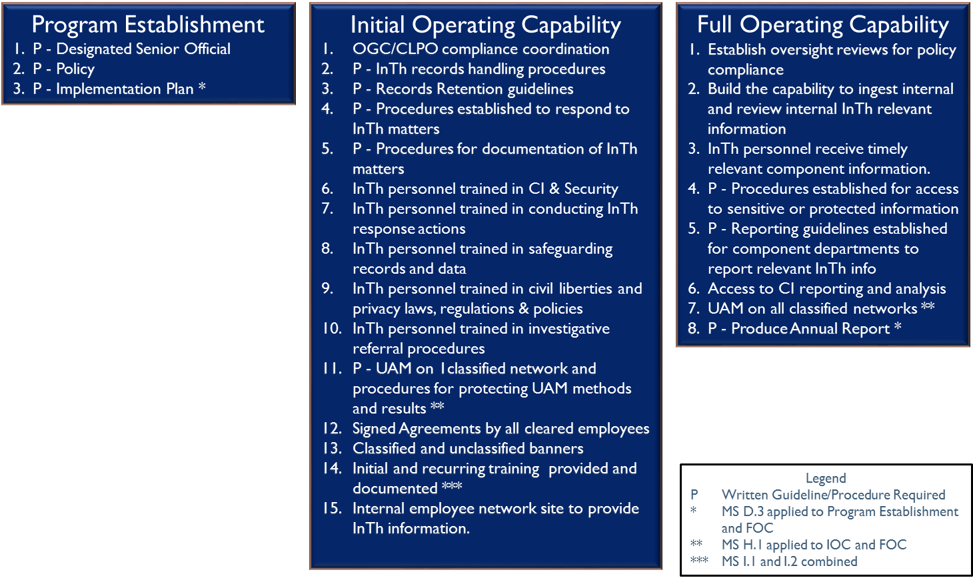
Insider Threat Program Milestones
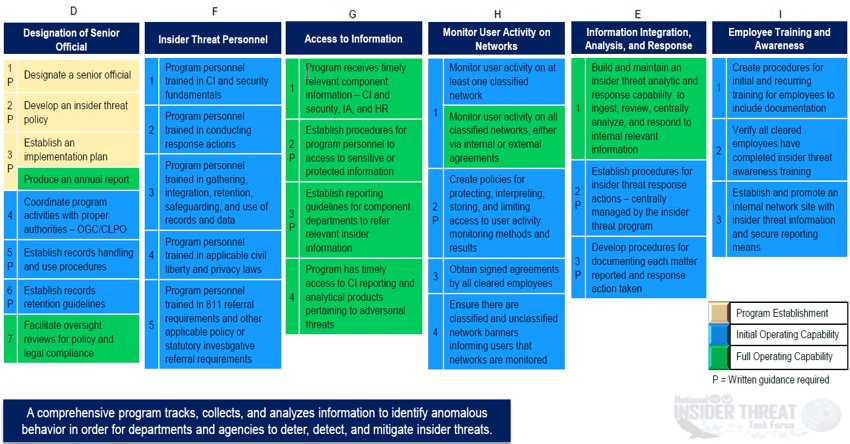
Insider Threat Minimum Standards by Category:
Goals and Objectives
Quote Box top
Shield Icon
Protect the homeland and US interests around the world
Integrate across agencies
Motivated and prepared workforce
Quote Box bottom
Leadership
"Fulfill our leadership role in the counterterrorism community"
1.1 Enhance strategic, tactical, and identities analysis using our access to foreign and domestic threat information and integrated data sets.
1.2 Strengthen the National Intelligence Manager— Counterterrorism role.
1.3 Advance government-wide counterterrorism planning, integration, coordination, and management.
Partnership
"Ensure our domestic and foreign partners have access to terrorism information and analysis when they need it."
2.1 Strengthen NCTC’s relationship with federal partners.
2.2 Enhance NCTC’s foreign government counterterrorism.
People
"Attract, develop, and reward a highly skilled workforce."
3.1 Attract a highly qualified, diverse workforce with an array of backgrounds, skills, and experiences, leveraging expertise from across the intelligence community and the US Government.
3.2 Increase training and professional development opportunities to expand and deepen the expertise of the NCTC workforce.
3.3 Ensure personnel are recognized, rewarded, and given access to the developmental resources they need to succeed.
Process
"Advance business practices to improve NCTC’s culture of collaboration, communication, and integrity."
4.1 Advance collaboration and integration across NCTC Directorates and Offices.
4.2 Improve processes to strengthen products and services to meet customer needs.
4.3 Enhance NCTC’s acquisition, sharing, and safeguarding of data in compliance with laws and policies designed to protect sensitive data.
4.4 Provide clear, consistent, and timely communications throughout NCTC.
Technology
"Enhance the use of information technology resources to strengthen NCTC’s core capabilities."
5.1 Deliver integrated information technology solutions that enable analytic production, seamless collaboration, and secure counterterrorism information sharing.
5.2 Implement and sustain a standards-based counterterrorism architecture and survivable infrastructure to drive efficiencies across the enterprise.
5.3 Define and implement transparent governance, acquisition management, and resource optimization processes to support evolving mission requirements.
 NITTF Outreach
Executive Order (E.O.) 13587 and the National Insider Threat Policy direct the NITTF to assist departments and agencies (D/A) in developing, implementing, and improving their Insider Threat Programs. The assistance effort is a collaborative process between the NITTF and the individual D/A. Through the assistance program, NITTF subject matter experts provide expertise, guidance, and advice on how best to achieve the Minimum Standards required for all insider threat programs. All components of the NITTF help facilitate the assistance mission in order to aid the executive branch D/As in meeting the requirements of E.O. 13587.
The NITTF Liaison Team is a critical part of the assistance program. Liaison Team members work directly with individual Federal Partners and select Department of Defense components. They provide direct assistance to insider threat program managers and personnel and help identify common solutions to common problems that are present across the enterprise. The Liaison Team also serves as an intermediary between D/As and the NITTF, helping identify task force resources, such as training or technical assistance, that may be beneficial to insider threat programs.
If you have any questions and/or insistence in establishing and insider threat office contact NITTF Assistance at This email address is being protected from spambots. You need JavaScript enabled to view it..