





These unique opportunities for U.S. undergraduate and graduate students offer important language-related components to their education.
Boren Scholarships provide unique funding opportunities of up to $20,000 for U.S. undergraduate students to study less commonly taught languages in world regions critical to U.S. interests and underrepresented in study abroad, including Africa, Asia, Central and Eastern Europe, Eurasia, Latin America, and the Middle East. In exchange for funding, Boren Scholars commit to working in the federal government for at least one year after graduation.
Boren Fellowships provide unique funding opportunities of up to $24,000 for U.S. graduate students to study less commonly taught languages in world regions critical to U.S. interests and underrepresented in study abroad, including Africa, Asia, Central and Eastern Europe, Eurasia, Latin America, and the Middle East. In exchange for funding, Boren Fellows commit to working in the federal government for at least one year after graduation.
These grants are awarded to U.S. universities recognized as leaders in the field of language education. They are designed to support university infrastructure to enhance student achievement of superior-level proficiency in critical languages.
Intelligence Community Centers of Academic Excellence (IC CAE)
IC CAE was congressionally mandated with the mission to increase intelligence community job applicants who are multi-disciplinary, as well as culturally and ethnically diverse. IC CAE provides grants to competitively accredited U.S. four-year colleges and universities to support the design and development of intelligence-related curricula.
English for Heritage Language Speakers Scholarship Program
A scholarship program for naturalized U.S. citizens fully proficient in critical languages seeking to apply their professional knowledge in a federal government career. The program held at Georgetown University in Washington, D.C., combines advanced English language training with professional communications skills and strategies.
 NITTF Policy & Legal
Executive Order (E.O.) 13587 (PDF) and the National Insider Threat Policy (PDF) directed the NITTF to develop a Government-wide policy for the deterrence, detection, and mitigation of insider threats, and, in coordination with appropriate agencies, develop minimum standards and guidance for implementation of the insider threat program’s Government-wide policy, both of which were signed by the President on 21 November 2012. The NITTF continually monitors these two foundational and dynamic documents, in collaboration with departments and agencies (D/A), to ensure they are meeting D/A needs as they develop and implement their insider threat programs.
NITTF promotes interdisciplinary and interprofessional collaboration across the executive branch of the U.S. Government with the Committee on National Security Systems and the National Institute of Standards and Technology publications on a range of related issues including continuous evaluation, privileged users, and privacy and civil liberties. The NITTF also ensures National Policy is aligned with D/A policy.
NITTF Core Documents
- Executive Order (E.O.) 13587: Structural Reforms to Improve the Security of Classified Networks and the Responsible Sharing and Safeguarding of Classified Information (PDF)
- National Insider Threat Policy and Minimum Standards for Executive Branch Insider Threat Programs (PDF)
- Summary of Federal Citations for the National Insider Threat Task Force (PDF)
Committee on National Security Systems (CNSS) Documents
- Committee on National Security Systems Directive (CNSSD) No. 504 - Directive on Protecting National Security Systems (NSS) from Insider Threat *
- Committee on National Security Systems Instruction (CNNSI) No. 1015 - Enterprise Audit Management Instruction for National Security Systems (NSS) (PDF)
- Committee on National Security Systems Instruction (CNNSI) No. 4009 – National Information Assurance (IA) Glossary (PDF)
Additional Insider Threat Related Documents
* This material is For Official Use Only, and has not been approved for public release. Please contact the NITTF if you have an official need for this item.
National Insider Threat Task Force (NITTF) Mission
National Insider Threat Task Force (NITTF) Mission
The primary mission of the NITTF is to develop a Government-wide insider threat program for deterring, detecting, and mitigating insider threats, including the safeguarding of classified information from exploitation, compromise, or other unauthorized disclosure, taking into account risk levels, as well as the distinct needs, missions, and systems of individual agencies.
Calendar Year 2026 Hub Ops Training
Calendar Year 2025 Hub Ops Training
Calendar Year 2024 Hub Ops Training
Establishment of NITTF
In October 2011, the president issued Executive Order (E.O.) 13587 (PDF) establishing the [National] Insider Threat Task Force (NITTF) under joint leadership of the Attorney General and the Director of National Intelligence. The president directed federal departments and agencies with access to classified information to establish insider threat detection and prevention programs, and the NITTF to assist agencies in developing and implementing these programs. In November 2012, following an extensive interagency coordination and vetting process, the president issued the National Insider Threat Policy and the Minimum Standards (PDF) via a Presidential Memorandum.
NITTF Products and Resources:
Provided below are some resources NITTF has available to the Inside Threat Community. To view additional resources please view our NITTF Resources Library.
NCSC has unveiled four updated documents to help organizations build effective insider threat programs from inception through maturity.


NITTF Announcements:
- NCSC and Partners Focus on "Deter, Detect, Mitigate" During National Insider Threat Awareness Month 2024
- October 2023 Enterprise Risk Mitigation Blueprint for Non-Intelligence Agencies
- NCSC and Federal Partners Focus on “Bystander Engagement” During National Insider Threat Awareness Month 2023
- 2023 Insider Threat Hub Operations Training
- NCSC and Federal Partners Focus on Countering Risk in Digital Spaces during National Insider Threat Awareness Month 2022
- Social Media And Insider Threat Risk, NITAM 2022 Bulletin 1
- Critical Thinking And Reducing Insider Threat Risk, NITAM 2022 Bulletin 2
- Critical Thinking As An Antidote to Misinformation and Influence Efforts, NITAM 2022 Bulletin 3
- Critical Thinking As An Antidote to Election Season Misinformation and Influence Efforts, NITAM 2022 Bulletin 4
- Understanding Why We Are So Susceptible to Mis/Disinformation, NITAM 2022 Bulletin 5
- NITTF whitepaper on State of Insider Threat Programs: Trends from Annual Reports, 2018-2020. Note, this product is only available to our US government partners. US government partners can contact the NITTF Client Engagement Group for a copy
- NCSC and Federal Partners Kick Off "National Insider Threat Awareness Month” 2021
- NITTF collaborated with CDSE to produce the Insider Risk Implementation Guide for the Food and Agriculture Sector.
- The Acting Director of the National Counterintelligence and Security Center has issued his letter of endorsement for the third annual National Insider Threat Awareness Month in September 2021. Please join us during September to emphasize the importance of safeguarding our nation by detecting, deterring, and mitigating insider threats. If you would like to increase awareness in your workforce, visit our partner the Center for Development of Security Excellence, to learn more about the serious risks posed by insider threats and how to recognize and report anomalous/threatening activities to enable early intervention.
- The National Counterintelligence and Security Center released Insider Threat Mitigation for U.S. Critical Infrastructure Entities: Guidelines from an Intelligence Perspective in March 2021. The publication is designed to raise awareness of insider threats to critical infrastructure organizations, provide information on how to incorporate this threat vector into organizational risk management, and offer best practices on how to mitigate insider threats.
- The National Threat Task Force (NITTF) released the Insider Threat Program Maturity Framework on November 1, 2018. The Framework is an aid for advancing federal agencies’ programs beyond the Minimum Standards, and builds upon best practices found in the 2017 NITTF Insider Threat Guide. The goal is to help programs become more proactive, comprehensive, and better postured to deter, detect, and mitigate insider threat risk.
- NITTF has developed technical bulletins to provide additional information to the insider threat community on technical topics existing within the Insider Threat community. Please review the NITTF Technical Page to view these bulletins.
- NITTF has added additional resources to the NITTF Resource Library in the Additional Insider Threat Resources section (formerly known as Briefings to the Insider Threat Community section). Please take some time to review these resources provided by members of the Insider Threat Community.
Mission
Lead and support the U.S. Government’s counterintelligence (CI) and security activities critical to protecting our nation; provide CI outreach to U.S. private sector entities at risk of foreign intelligence penetration; and issue public warnings regarding intelligence threats to the U.S.
Vision
NCSC is the nation’s premier source for counterintelligence and security expertise and a trusted mission partner in protecting America against foreign and other adversarial threats.
Strategic Goals
- Goal 1: Advance our Knowledge of, and our Ability to Counter Foreign and Other Adversarial Threats and Incidents
- Goal 2: Protect U.S. Critical Infrastructure, Facilities, Classified Networks, Sensitive Information, and Personnel
- Goal 3: Advance our Counterintelligence and Security Mission and Optimize Enterprise Capabilities through Partnerships
- Goal 4: Strengthen our Effectiveness through Stakeholder Engagement, Governance, and Advocacy
- Goal 5: Achieve our Mission through Organizational Excellence
Leadership
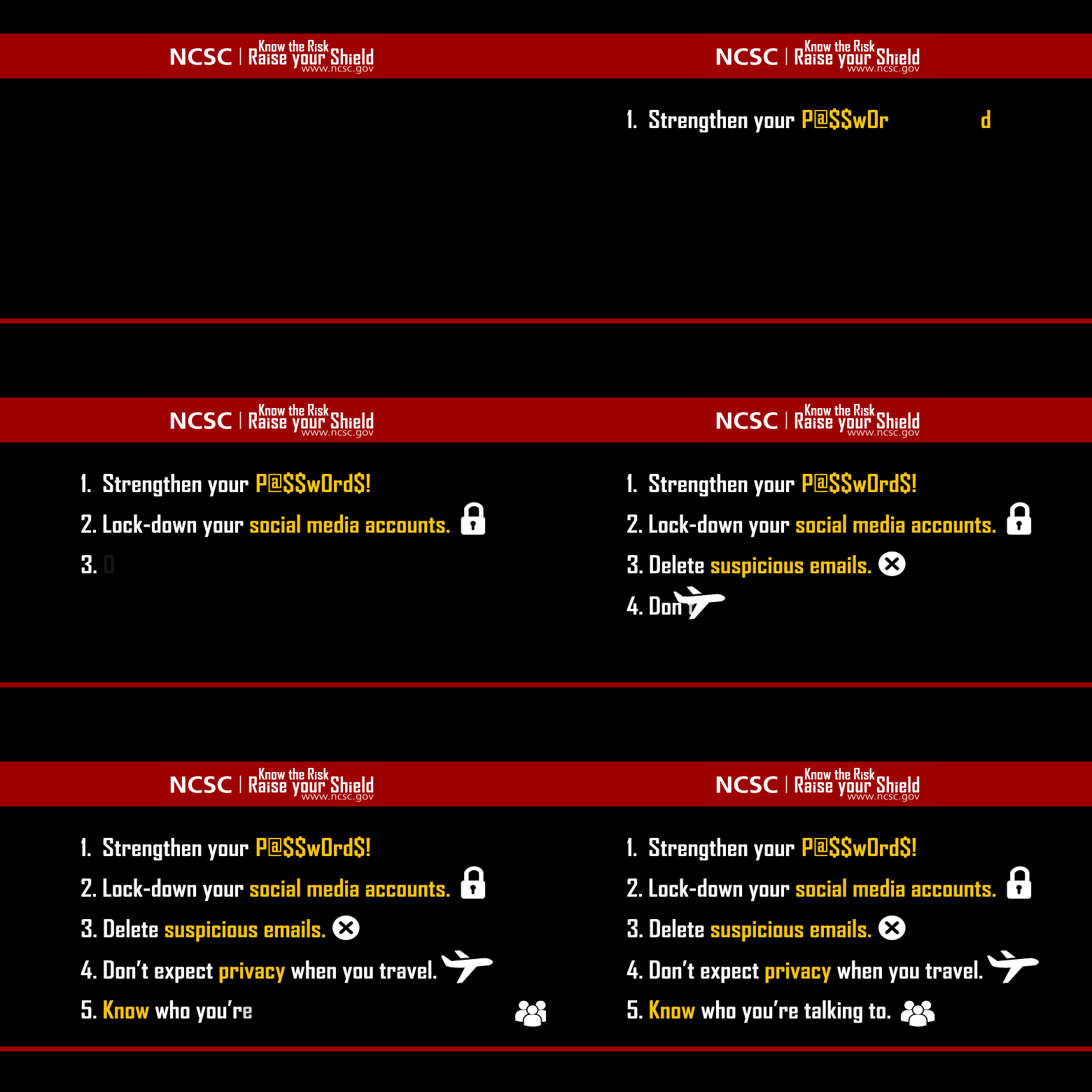
Know the Risk Raise Your Shield
CBS' 60 Minutes (23 December 2018) interviewed NCSC Director Evanina on the threat of Chinese espionage aginst the United States:
- "To Catch a Spy" segment on how a former CIA officer was caught betraying his country.
- "How China can spy on your electronics -- even in the United States" on 60 Minutes Overtime
Know the Risk | Raise Your Shield
Foreign intelligence entities, which may include foreign governments, corporations, and their proxies, are actively targeting information, assets, and technologies that are vital to both U.S. national security and our global competitiveness. The National Counterintelligence and Security Center is dedicated to raising awareness among government employees and private industry about these foreign intelligence threats, the risks they pose, and the defensive measures necessary for individuals and organizations to safeguard that which has been entrusted to their protection.
This campaign and related products will enable personnel to better understand these threats and provide guidance and tips for protecting the sensitive information, assets, technologies, and networks to which employees have access. It will also serve to help them protect their personal, confidential information that may be used by others to gain their trust.